

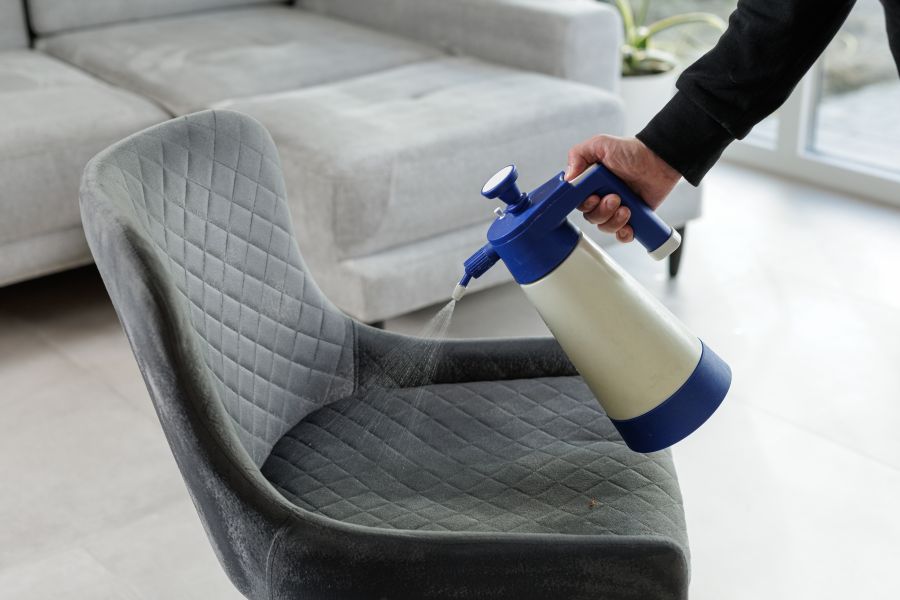
Take a quick inventory of your typical evening. You come home, drop your bag, and within minutes you’re probably sitting on something upholstered. Dinner might happen on the couch. TV definitely happens on the couch. Maybe you scroll through your phone there until your eyes blur. Eventually you migrate to a bed – also upholstered, technically. Then you do the same thing tomorrow.
The average person spends a significant percentage of their waking hours in direct physical contact with soft furniture. Skin pressed against fabric. Face occasionally buried in pillows. Breath circulating through the air immediately above and around these surfaces. It’s an intimate relationship, whether anyone thinks of it that way or not.
So what happens when that relationship involves furniture that’s quietly working against your health? Not dramatically. Not in a way that sends you to the emergency room. Just subtly, persistently, through mechanisms most people never connect to the actual source. The professional upholstery cleaning services NYC residents rely on exist primarily because this invisible burden accumulates faster than most people realize.
Starting With the Respiratory System

The lungs get the first hit, and they get it every single day. Every breath taken near heavily contaminated upholstery pulls in a cocktail of particulates – dust mite fecal matter, fungal spores, fiber fragments, volatile organic compounds released from trapped residues. None of these are lethal in normal concentrations. All of them contribute to background inflammation that the respiratory system then has to manage.
The American Lung Association has published guidance noting that indoor air quality can be two to five times worse than outdoor air in some environments, with soft furnishings contributing significantly to the problem.
What happens to respiratory health over time in a home with neglected upholstery:
- Chronic low-grade inflammation in nasal passages and airways
- Worsening of existing conditions like asthma or allergic rhinitis
- Reduced lung efficiency during sleep when breathing rates slow
- Increased susceptibility to respiratory infections due to persistent irritation
Hippocrates is credited with saying, “Let food be thy medicine and medicine be thy food.” An updated version for modern living might add: let your environment be medicine, because it will inevitably be something – either healing or subtly harming. Indifferent isn’t really an option.
The Immune System Connection

Here’s where things get interesting. The immune system isn’t just fighting off illnesses – it’s constantly calibrating its responses based on what it encounters. Chronic exposure to environmental allergens and microbial byproducts keeps parts of the immune system in a state of low-level activation. That’s exhausting on a biological level.
Research published in environmental health journals has examined what happens when indoor allergen loads are reduced. The findings are consistent: people with allergies, asthma, and related conditions show measurable improvements in symptom severity and frequency when dust mite populations in their homes drop. The Environmental Protection Agency has estimated that indoor allergen exposure contributes to millions of cases of allergic rhinitis annually in the United States alone.
Reducing the allergen reservoir in upholstered furniture creates:
- Lower baseline immune system activation
- Reduced production of histamine and other inflammatory compounds
- Better tolerance of occasional exposures when they do happen
- Less reliance on antihistamines and other symptom management medications
Think of it this way. An immune system that’s constantly responding to low-level threats at home has fewer resources available for actual challenges – seasonal viruses, unexpected exposures, the general work of staying healthy. Clearing the home environment reduces background noise so the system can focus on real issues.
What Your Skin Has to Say About It
The skin is the body’s largest organ, and it’s in constant contact with whatever surfaces you touch. Upholstered furniture you sit on, lean against, and rest your head on transfers microscopic material back and forth with your skin surface every time you make contact.
Dermatologists have noted that contact irritation and inflammation can arise from exposure to dust mites, fabric residues, and microbial buildups on furniture. While the research here is less definitive than for respiratory effects, certain patterns appear in clinical observation:
- Unexplained skin irritation that improves when household cleanliness improves
- Eczema flares in individuals sensitive to dust mite allergens, which can be triggered through direct skin contact as well as respiratory exposure
- Acne and folliculitis in areas that frequently contact dirty fabric, particularly face and upper body
- General skin sensitivity that normalizes in cleaner environments
Audre Lorde wrote: “Caring for myself is not self-indulgence, it is self-preservation.” Applied to the mundane task of upholstery maintenance, the principle holds up. The surfaces you’re in physical contact with every day count as part of personal care, even if the cultural conversation around “wellness” rarely frames it that way.
Sleep as a Health Variable
Now consider what happens at night. Mattresses are upholstered. Pillows are upholstered. That accent chair in the bedroom is upholstered. For roughly eight hours, the body is in sustained contact with soft surfaces while immune function, repair processes, and respiratory regulation all shift into their nighttime modes.
A study referenced by the National Sleep Foundation noted that indoor environmental factors, including allergen exposure from bedding and nearby furniture, significantly affect sleep quality metrics. Participants with reduced allergen exposure showed:
- Longer periods of uninterrupted sleep
- Fewer nighttime awakenings related to congestion or breathing disruption
- Reduced morning symptoms like headache, fatigue, and brain fog
- Improved subjective sleep quality on standardized assessments
Sleep quality is one of the most undervalued health variables in modern life. People will spend money on supplements, subscriptions, and wearable trackers to optimize sleep while simultaneously ignoring the fabric environment they’re literally sleeping in. The disconnect is striking when you actually notice it.
The Mental and Emotional Layer

There’s one more dimension worth mentioning, even though it’s harder to quantify. Environmental psychology has explored the connection between living space conditions and mental state, and the findings aren’t surprising in retrospect. Cluttered, visibly dirty, or sensorily unpleasant environments contribute to:
- Elevated cortisol levels and general stress response
- Reduced ability to relax in one’s own home
- Lower subjective life satisfaction
- Decision fatigue from constantly navigating a suboptimal environment
The mental load of living in a home that feels subtly off – without quite being able to identify why – is real. And upholstered furniture plays an outsized role in generating that feeling because it’s everywhere and it’s central to daily activity.
What Regular Professional Cleaning Actually Accomplishes
Pulling all of this together, expert upholstery cleaning provides several health-adjacent benefits that don’t always get labeled as health benefits:
- Physical removal of embedded allergens rather than surface masking
- Microbial reduction through methods like UV-C treatment, hot water extraction, and enzyme-based solutions
- Improvement of indoor air quality by eliminating secondary pollution sources
- Reduction of skin contact with contaminated surfaces
- Protection of sleep environment integrity when bedroom upholstery is included
- Lower cumulative exposure to the chemical residues of repeated DIY cleaning attempts
The frequency that makes sense depends on household variables. Pets, allergies, children, heavy use, and high humidity all argue for more frequent professional attention. Minimal-use furniture in dry, low-traffic homes can stretch longer between services.
Beyond the Checklist
It would be easy to frame upholstery cleaning as one more item on an endless health maintenance checklist. Eat well, exercise, manage stress, sleep enough, drink water, clean your furniture. But that framing misses the point. Healthy living isn’t a to-do list – it’s an accumulation of small environmental and behavioral choices that either support well-being or quietly undermine it.
Mahatma Gandhi observed: “It is health that is real wealth and not pieces of gold and silver.” He was speaking broadly, but the principle applies to the most unglamorous details of daily life. The health consequences of spending years in close contact with contaminated upholstery aren’t dramatic enough to make anyone panic. They’re also significant enough that ignoring them is a choice with real consequences.
Taking care of the surfaces you spend the most time on isn’t an indulgence or a luxury service. It’s infrastructure for actually feeling good in your own home. Which, when you think about it, might be the whole point of having a home in the first place.