

If you’ve been comparing cannabis products lately, you’ve probably noticed how often Delta 8 and Delta 9 come up. The names are nearly identical, which makes the topic confusing at first. But once you break it down, the differences are practical and easy to understand.
These two compounds belong to the same group, yet they behave differently in the body, are produced in different ways, and fall under different legal rules. That combination is why people keep asking about Delta 8 vs Delta 9 THC.
The goal here is to explain those differences clearly so you can make sense of what you’re seeing on labels and in stores.
What These Two Compounds Actually Are
Both compounds are cannabinoids found in cannabis plants. They interact with the body’s internal system that regulates mood, appetite, and perception. That interaction is what creates the familiar “high.”
The better-known version is Delta 9. It appears naturally in larger amounts and has been studied more extensively. It is the main psychoactive component in cannabis.
Delta 8 exists too, but only in very small concentrations. Most products on the market are made by converting CBD into this compound through chemical processing.
Hemp Derived THC vs THC – Why the Source Matters
A lot of confusion around Delta 8 vs Delta 9 THC comes from how these compounds are sourced. The distinction between hemp-derived and cannabis-derived products explains why one is easier to find than the other.
When people compare hemp derived thc vs thc, they’re usually trying to understand legality and origin. Hemp products are federally defined as containing less than 0.3 percent of the stronger psychoactive compound.
Because Delta 8 is often made from hemp-based CBD, it became widely available under that legal threshold.
The more potent form, however, is still regulated in many places and typically sold through licensed dispensaries.
So when you compare these two, the source directly affects how they are sold, labeled, and controlled.
The Chemical Difference (Simple but Important)
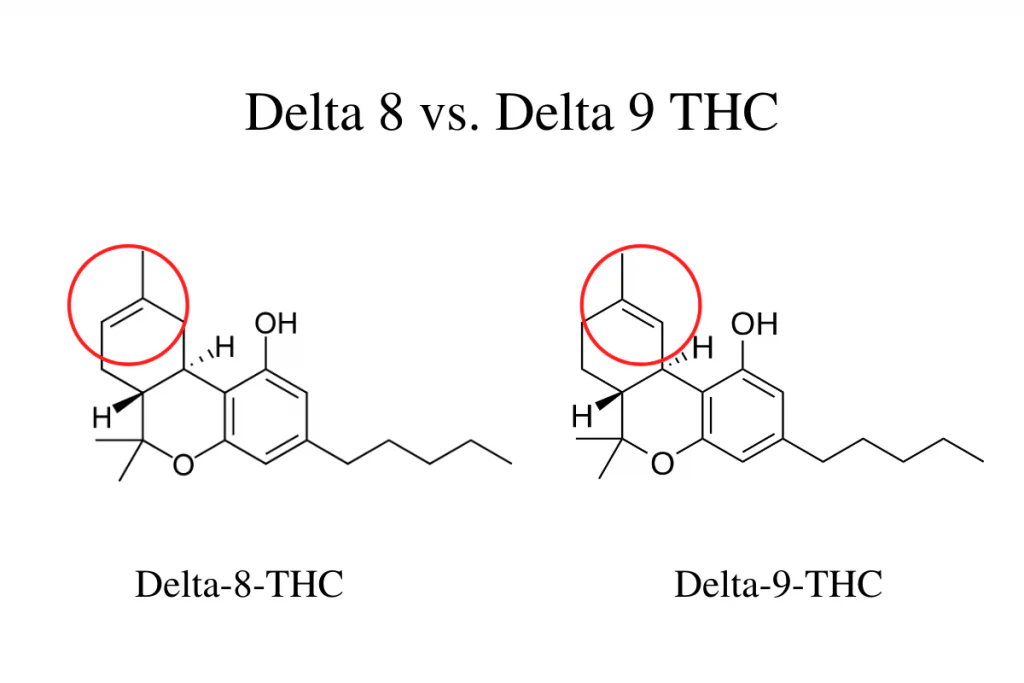
From a chemistry standpoint, these compounds are almost identical. The difference comes down to the position of a single double bond in their molecular structure.
In one version, the bond sits on the eighth carbon chain. In the other, it sits on the ninth.
That small structural shift changes how strongly each compound binds to receptors in the brain.
- The ninth-position version binds more strongly
- The eighth-position version binds more weakly
This difference explains why one feels stronger than the other.
Effects and Potency Compared
When people look up Delta 8 vs Delta 9 THC, they usually want to know how the experience differs.
The more common version produces stronger psychoactive effects. These can include euphoria, altered perception, and sometimes anxiety depending on dose and tolerance.
The alternative version tends to feel milder. Many users describe it as more manageable and less overwhelming.
Here’s a quick comparison:
| Feature | Milder variant | Stronger variant |
| Intensity | Lower | Higher |
| Mental clarity | More stable | More impairing |
| Typical use | Relaxation | Strong effects |
Research also suggests the milder version is somewhat less potent overall, though results depend on dosage and method of use.
So the difference is mostly about strength and predictability.
How Production Methods Affect Safety
Another key part of the Delta 8 vs Delta 9 THC discussion is how these products are made.
The stronger compound is naturally abundant in cannabis plants and can be extracted directly.
The milder one is usually synthesized from CBD because natural levels are too low for commercial use.
That extra processing step introduces some concerns:
- Residual chemicals from conversion processes
- Variations in product purity
- Inconsistent labeling and testing
This does not mean all products are unsafe, but it does mean quality depends heavily on the manufacturer.
Legal Differences You Should Know
Legal status is one of the biggest practical differences between these two compounds.
The stronger version is still federally restricted in many regions, even though some states allow it under regulated systems.
The milder version exists in a more flexible legal space because it can be derived from hemp. However, laws vary widely by location.
Here’s the simplified breakdown:
- One is tightly regulated and sold through licensed channels
- The other is more widely available but less consistently controlled
That difference affects everything from pricing to product quality.
Faqs
Final Thoughts
Delta 8 vs Delta 9 THC is not just a technical comparison. It reflects real differences in potency, production, and regulation.
One is stronger, more studied, and tightly controlled. The other is milder, more accessible, but less standardized.
Understanding those differences helps you make better decisions, especially in a market where products can look similar but vary significantly in how they behave.