


Blockchain is increasingly being used as infrastructure for verification, traceability, settlement, credentials, and programmable records, not only for cryptocurrency trading.
Prominent non-trading applications include supply-chain provenance, digital credentials, cross-border public services, institutional payments, tokenized assets, and data notarization. Adoption ranges from live production systems to pilots. Blockchain tends to add the most value when several independent parties need to work from one shared, verifiable record.
Key Takeaways
- Blockchain’s value beyond trading often comes from giving multiple organizations access to a shared, tamper-evident record without putting one party in complete control.
- Many enterprise and government applications use permissioned distributed-ledger infrastructure rather than public cryptocurrency networks.
- Supply-chain traceability and verifiable credentials are prominent non-trading use cases.
- Financial institutions are exploring tokenization and distributed ledgers for settlement and collateral movement.
- Blockchain can make unauthorized changes easier to detect, but it cannot guarantee that information was accurate when entered.
- When one trusted operator already controls a process, a conventional database may remain simpler and cheaper.
Why Blockchain Can Be Useful Without Cryptocurrency Trading

Blockchain technology and tradable cryptocurrencies are related but not the same thing.
At its simplest, a blockchain provides a record that several participants can maintain or verify under agreed rules. Cryptographic links between entries can make later unauthorized changes easier to detect, while smart contracts can automate predefined actions or validation rules.
Networks can be public, private, permissioned, or hybrid. In many business and government applications, users never need to buy or trade a cryptocurrency.
The more useful questions are therefore: Who needs to access the record? Who can update it? Who needs to verify it? And is there a reason one organization should not control the entire database?
6 Ways Blockchain Is Being Used Beyond Crypto Trading
These applications sit at different stages of maturity, from operating commercial platforms to institutional pilots.
1. Supply-Chain Tracking and Product Provenance

Blockchain can help organizations record product origin, processing, certifications, and transfers across a supply chain.
Diamond traceability provides a practical example. Tracr, backed by De Beers, records natural diamonds from their source and creates a tamper-evident history that can support provenance verification. According to GIA and De Beers, more than five million rough diamonds had been registered at source by May 2026. GIA also agreed in May to acquire a 30% stake as Tracr develops toward a broader industry platform.
The important limitation is the input problem. Blockchain can make unauthorized changes to recorded data easier to detect, but it cannot guarantee that the information was accurate when entered.
2. Digital Identity, Diplomas, and Verifiable Credentials
Verifiable credentials allow an organization to issue a digitally signed credential that another party can later verify.
A university, for example, could issue a qualification to a student’s digital wallet. An employer could then check its cryptographic proof without repeatedly contacting the university.
The European Blockchain Services Infrastructure, or EBSI, has supported pilots involving verifiable credentials for areas including education, social security, organizations, and other cross-border use cases.
It has also supported track-and-trace experimentation. These should not be described as universally deployed EU-wide production services. EBSI’s governance is evolving through EUROPEUM-EDIC as the infrastructure prepares for broader production use.
3. Government Records and Cross-Border Public Services
The same underlying infrastructure can also serve a broader purpose: allowing public authorities in different countries to verify and exchange trusted information without relying on a single national database.
Governments can use distributed infrastructure to support document verification, trusted data exchange, notarization, and cross-border administrative processes.
EBSI illustrates the model. Rather than replacing every government database, it has been developed as infrastructure through which public authorities and other participants can test ways to exchange and verify information across organizational and national boundaries.
The European Commission describes EBSI as having deployed a pilot network of more than 40 nodes for projects including credential verification and anti-counterfeiting use cases. EUROPEUM-EDIC is intended to extend this work into the production phase.
4. Cross-Border Payments and Financial Settlement
Financial institutions are also testing tokenization, permissioned distributed ledgers, and shared settlement infrastructure rather than relying only on public cryptocurrency networks.
Project Agorá, convened by the Bank for International Settlements and the Institute of International Finance, is a major example. On May 27, 2026, the BIS reported that its prototype had demonstrated atomic settlement using tokenized commercial-bank deposits and central-bank reserves. Atomic settlement means the required parts of a transaction complete together or none do.
The project then progressed to real-value testing in July. Twenty-eight financial institutions and central banks completed transactions totaling approximately CHF 800,000 across 17 scenarios. The BIS reported an average of about 80 seconds from payment initiation to settlement in the controlled testing environment.
This remains experimental institutional infrastructure rather than an ordinary consumer payment service.
5. Tokenized Real-World Assets and Collateral

Tokenization represents ownership of, or rights to, an existing asset on digital-ledger infrastructure. The underlying asset might be a Treasury security, bond, fund interest, deposit, or collateral rather than a cryptocurrency.
This distinction matters because tokenized real-world assets serve a different purpose from conventional crypto-market activity, where users may visit an exchange to trade ATLA/USDT or other digital-asset pairs.
DTCC demonstrated this transition on July 15, 2026, when DTC-held securities were converted into tokens and used in live production transactions involving Treasury and equity assets. DTCC reported participation from about 40 firms across the day’s production-trade program.
Those transactions should not be confused with completion of DTCC’s broader roadmap. As of October 1, DTCC still describes the Tokenization Service launch as expected in October 2026. Its separate Collateral AppChain, designed as shared infrastructure for institutional collateral movement, is expected to go live in Q4 2026. Both milestones therefore remain prospective until DTCC confirms their completion.
6. Data Integrity, Notarization, and Audit Trails
Blockchain can also record evidence that a document existed at a particular time and help reveal whether the recorded representation was subsequently changed.
Organizations do not necessarily need to place an entire document on-chain. They can store a cryptographic hash, or digital fingerprint, while keeping the underlying file elsewhere.
EBSI includes notarization and trusted-data applications within its broader use-case work. The distinction remains important: a blockchain can provide evidence about the history and integrity of a recorded item, but it does not prove that the original claim or document was truthful.
What Problems Is Blockchain Actually Trying to Solve?
The business problem should come before the technology.
A blockchain use case is stronger when it solves a coordination or verification problem that would otherwise require several organizations to reconcile separate records. The comparison below shows where that advantage is most likely to matter.
|
Business problem |
How blockchain may help |
When it may not help |
|
Several companies need one shared record |
Shared ledger and common verification rules |
One company already controls the workflow |
|
Records must be difficult to alter unnoticed |
Cryptographic audit trail |
Ordinary database logs provide sufficient assurance |
|
Credentials need independent verification |
Verifiable credentials |
The issuer can easily be queried directly |
|
Assets or payments pass through several intermediaries |
Programmable settlement and reconciliation |
Existing payment rails already work efficiently |
|
Product history crosses many organizations |
Shared provenance record |
Source data cannot be verified reliably |
Blockchain becomes more compelling when coordination, independent verification, and shared governance are genuine requirements rather than features added after the technology has already been chosen.
Blockchain Does Not Automatically Make a System Trustless
Blockchain changes how trust is distributed. It does not eliminate trust.
The Oracle or Input Problem
If incorrect information enters a ledger, blockchain may preserve that incorrect information consistently. A fraudulent certificate recorded on-chain remains fraudulent.
This means source-data quality, identity verification, sensors, auditors, or other external inputs can be just as important as the blockchain itself.
Governance Still Matters
Every practical network needs rules for who operates nodes, who can submit data, how mistakes are handled, who updates software or smart-contract rules, and how disputes are resolved.
Privacy and Regulation Still Apply
Sensitive personal or commercial data may be unsuitable for direct on-chain storage. Common approaches include storing hashes instead of raw records, keeping documents off-chain, and controlling access through permissioned systems.
For this reason, enterprise blockchain frequently involves controlled participation rather than unrestricted decentralization.
When Is a Traditional Database Better Than Blockchain?
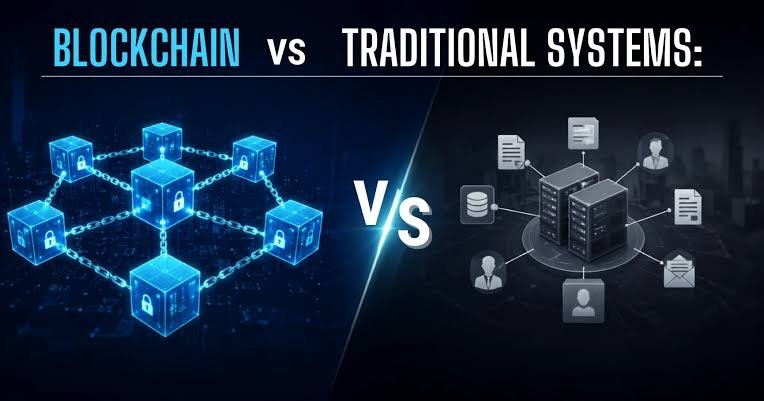
For systems controlled by one trusted organization, a conventional database will often be the simpler option.
It may be preferable when records need frequent deletion or editing, very high throughput is important, participants already trust a central administrator, or there is little need for independent verification.
Blockchain has a stronger case when several independent organizations share responsibility, no participant should have unilateral control, auditability or provenance matters, and information or assets must move across institutional boundaries.
A useful rule of thumb is: Multiple parties + shared state + limited mutual trust + need for verifiability = a stronger case for blockchain.
That still does not mean blockchain is automatically the best architecture. Cost, privacy, governance, interoperability, and operational complexity all need to be considered.
Conclusion
Blockchain’s role increasingly extends beyond cryptocurrency trading into infrastructure for verification, traceability, settlement, credentials, and tokenized assets.
The most useful way to evaluate these projects is not to ask whether blockchain can be used, but whether multiple parties genuinely need a shared record that none of them should control alone.
The same logic applies to projects involving XRP, tokenized deposits, or central-bank reserves. XRP is best known as a tradable digital asset, but its more relevant enterprise angle is the XRP Ledger, which has been used to explore faster cross-border settlement and liquidity management
. That does not make it automatically superior to existing payment rails — it simply illustrates the broader point: the technology matters less than whether it solves a real coordination problem between independent parties.
If a conventional database can solve the same problem more simply, blockchain may add little. If independent verification, shared governance, and cross-organizational coordination are essential, distributed-ledger infrastructure becomes much easier to justify.