

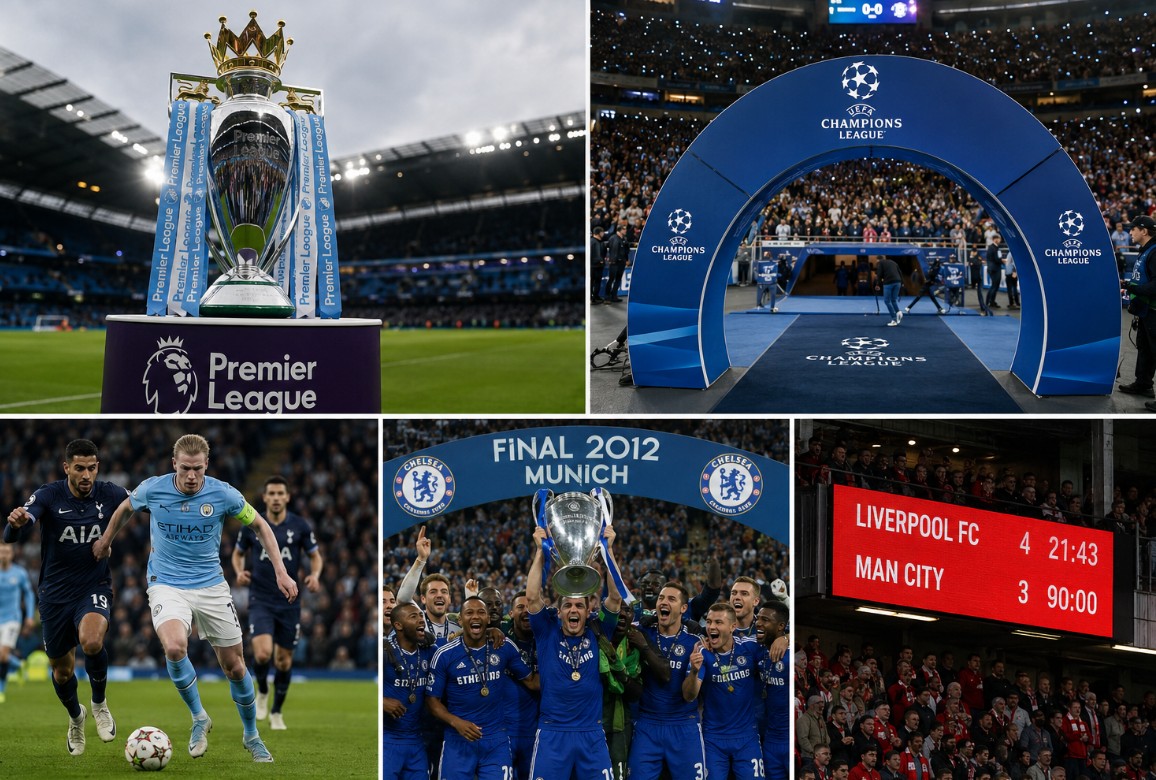
Premier League and Champions League competitions test teams in very different ways. England’s top division uses a 38-game league format, while Europe’s leading club competition places far more weight on knockout rounds.
Predicting a Premier League champion usually means judging which club can produce elite results across an entire season.
Champions League predictions depend more heavily on short-term form, injuries, matchups, and decisive moments in individual games.
Difficulty also needs to be separated into two ideas. Winning a competition and predicting its winner are not the same challenge.
Premier League success demands sustained consistency, while Champions League success can depend on surviving a much smaller number of critical matches.
Why the Champions League Is Harder to Predict

Knockout soccer creates much greater uncertainty because individual matches carry far more weight. One mistake can end an entire campaign, especially in quarterfinals, semifinals, and finals.
Short-term form also has a larger impact. A team can dominate domestically for months, enter Europe as a favorite, and still lose after one poor performance.
That uncertainty is especially relevant when assessing a sport bet, since injuries, suspensions, penalties, refereeing decisions, and goalkeeper errors can all change the result of a tie very quickly.
Knockout Games Increase Variance
Fewer matches mean fewer chances to correct mistakes. A Premier League contender can lose unexpectedly and still recover over the next several weeks.
A Champions League club may not get another opportunity after a bad night.
Several events can immediately change a knockout tie:
- An early red card can force a team to defend with 10 players.
- A missed penalty can waste one of only a few clear scoring chances.
- A late defensive error can decide an otherwise balanced matchup.
- An injury to a key player can alter both tactics and attacking quality.
- A penalty shootout can eliminate a stronger team after an even contest.
Such moments carry more influence because the competition offers little recovery time.
Manchester City’s European Exits
Manchester City’s record under Pep Guardiola shows how often elite clubs can fall short in Europe.
City regularly entered the Champions League among the strongest teams in the competition, yet several opponents eliminated them before their 2023 title.
Notable eliminations included:
- Monaco
- Liverpool
- Tottenham
- Lyon
- Chelsea
- Real Madrid
Domestic success did not protect City against knockout pressure. Strong league form, expensive squads, and high possession numbers could not guarantee progression once a tie came down to a small number of decisive moments.
Those exits are important for prediction because they show how difficult it is to rely only on overall team quality.
A club can be better across an entire season and still lose a two-game tie.
Upsets Can Reshape an Entire Tournament
Champions League history also contains examples of clubs outperforming expectations at exactly the right time.
Chelsea finished sixth in the Premier League during the 2011-12 season but still won the Champions League after beating Bayern Munich in the final.
Domestic league position therefore offered only a limited indication of Chelsea’s European chances.
Another major example arrived in 2004, when Porto met Monaco in the final. Very few preseason predictions would have expected that matchup.
Results like those show how one upset can change the path for several other clubs. Once a favorite is eliminated, another contender may receive a more favorable route toward the final.
Why the Premier League Is Easier to Predict

A 38-game schedule gives stronger teams more opportunities to prove their quality across a large sample of matches.
One poor result rarely ruins a title challenge because clubs have enough games to recover lost points and rebuild momentum.
Long seasons also reduce the influence of random events.
A red card, missed penalty, defensive mistake, or unexpected injury can affect a single result, but those moments usually carry less weight across an entire campaign.
Consistency Matters More Over 38 Games
League competition rewards teams that can perform at a high level week after week. Predictors can evaluate clubs across many matches instead of relying heavily on short bursts of form.
Results also become more reliable as the season develops.
Strong attacking numbers, defensive stability, squad depth, and points gained against different types of opponents give a clearer picture of which clubs can sustain a title challenge.
Liverpool’s recent title races show how demanding that standard can become.
Two seasons produced extraordinary point totals without a championship:
- 97 points in 2018-19
- 92 points in 2021-22
Manchester City finished above Liverpool in both campaigns. Those results show how difficult league success can be even for a team performing at an elite level.
Such consistency also helps explain why prediction can become easier.
Clubs capable of maintaining that pace usually separate themselves over time, leaving fewer realistic title contenders as the season progresses.
Squad Depth Reduces Uncertainty
Squad strength becomes increasingly important during a long domestic campaign.
Injuries, suspensions, fatigue, and fixture congestion affect every club, so teams with stronger benches are better equipped to handle disruptions.
A title contender with several high-level replacements can absorb the absence of a starter without suffering a major decline.
Smaller squads usually have less protection when key players miss several matches.
Predictors can account for that depth before and during a season.
Clubs with proven starters, reliable substitutes, and greater rotation options are generally less vulnerable to short-term problems.
Pep Guardiola has argued that league success is especially difficult because high-level performance must continue across months of competition.
That same structure can make the winner easier to forecast, since quality is tested repeatedly rather than across only a few decisive games.
Money and Squad Strength
Premier League clubs often enter European competition with major financial advantages. Large transfer budgets, expensive squads, and greater depth can make English clubs look stronger on paper than many opponents.
Financial power still does not guarantee Champions League success.
Knockout rounds reduce some of the protection that money provides because one poor performance can outweigh months of strong results.
Why Squad Depth Matters More in a League
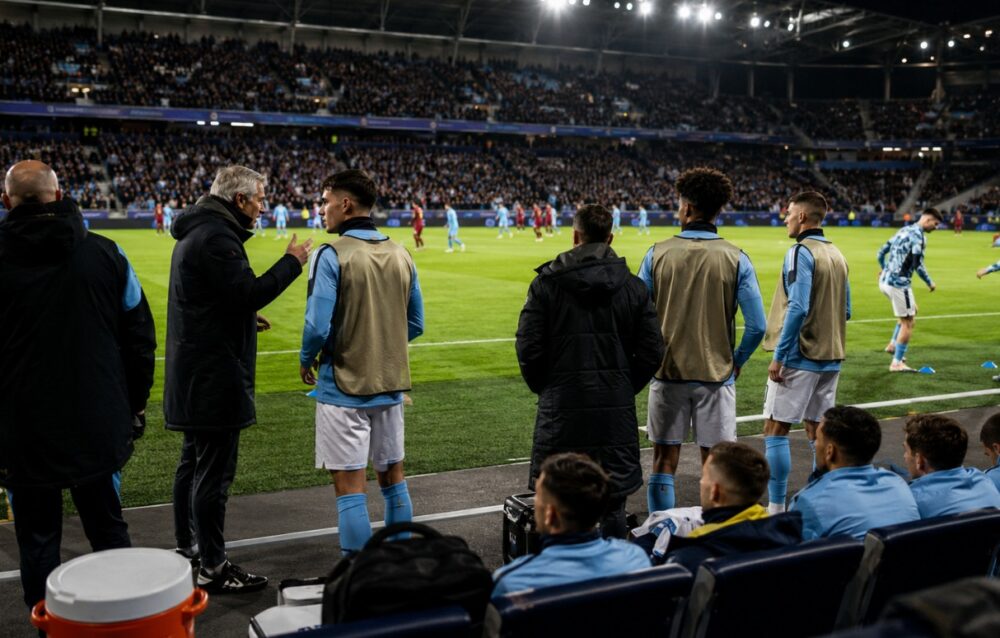
A long domestic season places constant pressure on a squad. Clubs must manage league fixtures, cup games, injuries, suspensions, and player fatigue over many months.
Wealthier teams can often replace unavailable starters with high-level alternatives. That advantage can prevent a temporary injury crisis or heavy schedule from turning into a long run of poor results.
Squad depth also gives managers more tactical options.
Different opponents may require different midfield structures, attacking profiles, or defensive approaches, and stronger benches make those adjustments easier.
For prediction purposes, financial strength can therefore make elite Premier League clubs more reliable across a full season.
Better depth usually lowers the risk created by injuries and fatigue.
Knockout Soccer Reduces Financial Protection
Champions League ties work differently because a club may only have one or two matches to prove its superiority. Spending power cannot erase a major mistake after it happens.
An expensive squad may still struggle against a well-organized opponent that defends effectively and creates a few dangerous counterattacks.
One unfavorable matchup can neutralize part of the quality advantage that looked obvious on paper.
Individual availability also becomes much more important at this stage. Missing a star for several league matches can hurt, but later fixtures offer opportunities to recover.
Missing that player during a Champions League semifinal can affect the entire outcome of the competition.
Manchester City’s attacking quality provides a clear example of how much key players can influence a major tie:
- Kevin De Bruyne can control tempo, break defensive lines, and create chances against compact opponents.
- Erling Haaland can turn limited opportunities into goals through movement, positioning, and finishing.
Losing either player at the wrong point in the competition can reduce City’s attacking threat considerably.
Strong squad depth can soften the impact, but replacing an elite player in a decisive European match is much harder than covering an absence across several domestic fixtures.
Financial strength therefore improves a club’s chances, but it does not make Champions League outcomes easy to forecast.
Knockout pressure gives timing, availability, and individual moments much greater influence than they usually have across a 38-game league season.
Summary

Champions League soccer is harder to predict.
Premier League competition is arguably harder to win because champions must perform at an elite level across 38 matches. Sustained consistency, squad depth, fitness, and mental endurance all shape a successful title campaign.
Champions League competition creates greater prediction difficulty because fewer matches give individual events more influence.
League soccer usually gives superior teams enough time to recover and prove their quality. Knockout soccer gives weaker teams a better chance to produce one exceptional performance and eliminate a favorite.