

Niu Niu looks confusing for about five minutes, then it starts to click.
At first glance, you see five cards, fast decisions, strange hand names, and players calling out scores with total confidence. For a beginner, that can feel like a lot. Once you know the basic structure, though, the game becomes much easier to follow. You stop staring at your cards and start spotting patterns almost right away.
Niu Niu, sometimes called Bull Bull, is a comparing card game built around making a valid hand from five cards. A round moves quickly. Players get cards, arrange them into a certain pattern, and compare results. Luck matters, sure, though memory, speed, and pattern recognition matter too.
What Niu Niu Is
Niu Niu is usually played with a standard 52-card deck. Some versions add jokers, though beginners should learn with the plain deck first. Most games involve 2 to 6 players, and many tables use one player as the banker.
The goal is simple: make a hand that qualifies under Niu Niu rules, then beat the banker or beat the other players, depending on the version.
A basic rules reference can be useful here, especially for readers who want to see the standard structure of a round before moving on to real-game environments like JB.com. This helps bridge the gap between learning the basics and actually keeping up with real gameplay.
A normal round goes like this:
- Each player receives 5 cards
- Players sort their cards into a 3-card group and a 2-card group
- The 3-card group must total a multiple of 10
- The remaining 2 cards decide the score
- Hands are compared
- Payouts are made based on rank and table rules
That is the whole skeleton of the game. Everything else comes from scoring and hand ranking.
Card Values in Niu Niu
Before scoring makes sense, card values need to be clear.
| Card | Value |
| Ace | 1 |
| 2 to 9 | Face value |
| 10 | 10 |
| J, Q, K | 10 |
Suits usually do not matter for ordinary scoring. In some house rules, suits may break ties.
For beginners, one habit helps a lot: stop thinking in poker terms. A king is not “high” in the usual sense. In Niu Niu, face cards are mainly worth 10.
Core Rule Behind a Valid Hand
Here is the part that defines the whole game.
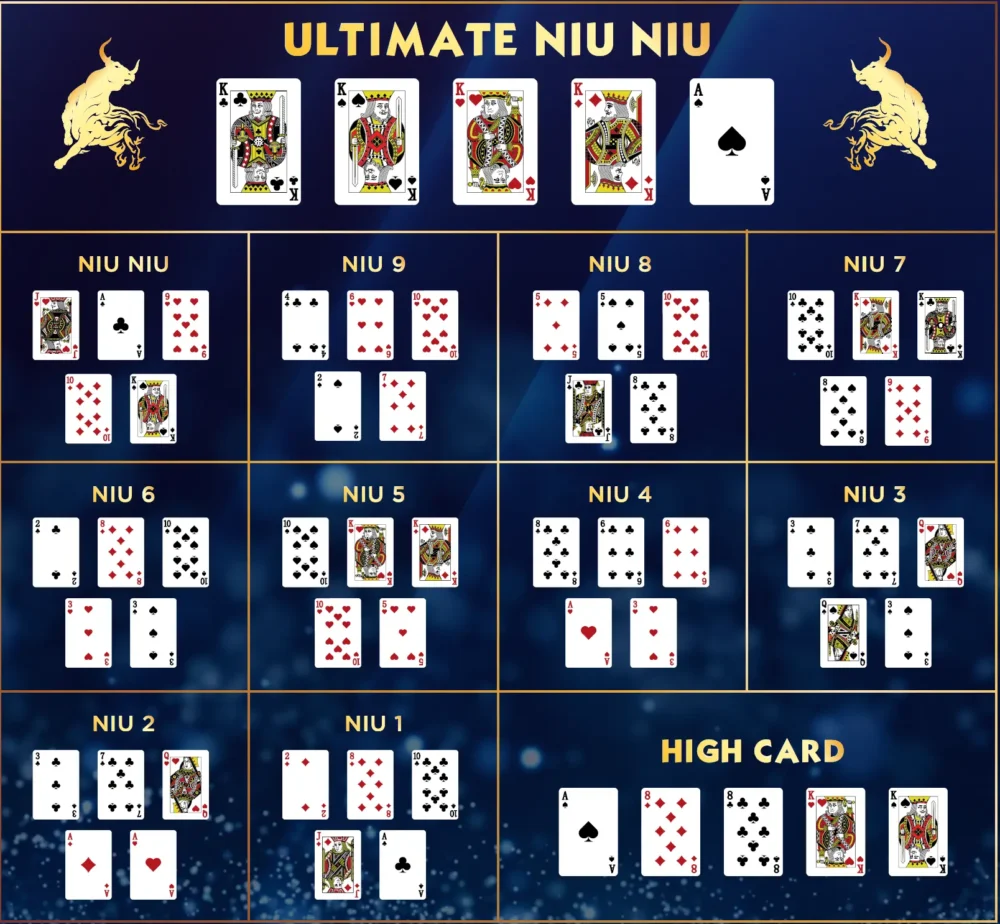
From your 5 cards, you need to find any 3 cards whose total is a multiple of 10.
Examples of valid 3-card totals:
- 10
- 20
- 30
If you can do that, your hand qualifies. Then you add the remaining 2 cards. Their total determines your Niu value.
Only the last digit matters.
So if the remaining 2 cards add up to:
- 11, score is Niu 1
- 17, score is Niu 7
- 20, score is Niu Niu
Niu Niu, or Bull Bull, is the best standard result in many common versions.
How Scoring Works
Let’s make that easier with examples.
Example 1: Niu 7
Your 5 cards are:
- 6
- 4
- 9
- 5
- 2
Pick 6 + 4 + 10? No 10 is not there. Try 9 + 5 + 6 = 20.
Great, that works.
Now the remaining cards are 4 and 2.
4 + 2 = 6
That hand is Niu 6.
Example 2: Niu Niu
Your 5 cards are:
- K
- Q
- 10
- 8
- 2
K + Q + 10 = 30
That forms the valid 3-card group.
Remaining cards: 8 + 2 = 10
That gives Niu Niu.
Example 3: No Niu
Your 5 cards are:
- 7
- 8
- 4
- 3
- A
Now you check every possible 3-card combination and none adds up to 10, 20, or 30.
That hand is No Niu, sometimes called “no bull.”
Standard Hand Rankings
House rules can change ranking slightly, though a beginner can safely learn the common order below.
| Rank | Hand |
| Lowest | No Niu |
| Niu 1 | |
| Niu 2 | |
| Niu 3 | |
| Niu 4 | |
| Niu 5 | |
| Niu 6 | |
| Niu 7 | |
| Niu 8 | |
| Niu 9 | |
| Highest standard hand | Niu Niu |
So yes, Niu 9 is strong, though Niu Niu beats it.
Many tables also include special hands above Niu Niu. More on that in a moment.
Special Hands You May See
Some Niu Niu games add bonus hands with higher ranks and bigger payouts. Rules vary a lot from table to table, so always check before play starts.
Common special hands include:
Five Face Cards
All 5 cards are J, Q, or K.
Example:
- J
- Q
- K
- J
- Q
Bomb
4 cards of the same rank.
Example:
- 9
- 9
- 9
- 9
- K
Five Small Niu
All 5 cards are small, often 4 or lower, and the total is low enough to meet the table rule.
Example:
- A
- 2
- 2
- 3
- 4
Some versions treat Five Small Niu as the strongest hand on the table.
How a Round Usually Works
A beginner learns faster by seeing the flow of a full round.
1. Choose the Banker
One player acts as banker. In some versions, the role rotates. In others, players compete for it.
The banker matters because everyone usually compares hands directly against that one player.
2. Place Bets
Non-bankers place their bets before cards are revealed, depending on table rules.
3. Deal 5 Cards to Each Player
Cards are dealt face down.
4. Arrange the Hand
Each player looks for a 3-card total that makes a multiple of 10. Then they calculate the last 2 cards.
5. Reveal Hands
Players show results, often starting with non-bankers.
6. Compare With the Banker
Each player’s hand is compared against the banker’s hand. Higher rank wins.
7. Pay Out
Winnings are paid according to the hand rank and any multiplier rules.
What Happens in a Tie
Ties depend on house rules, though common tie-break methods include:
- Banker wins the tie
- Highest single card decides
- Suit ranking decides
- Special hands automatically beat standard hands
A lot of confusion at casual tables comes from tie rules, not from scoring. Ask before the first round. Saves a headache.
Beginner Tips That Actually Help
A new player does not need fancy strategy. You need a clean way to read hands quickly.
Look for Tens First
Face cards are all worth 10, so scan for them right away. Any group with a 10-value card can be easier to organize.
If you hold:
- K
- 7
- 3
- 5
- 5
Start with 7 + 3 + K = 20.
That kind of shortcut speeds up play a lot.
Learn Common Pair Patterns
Once your 3-card group is found, the final 2 cards decide everything.
Keep an eye on easy finishing pairs:
- A + 9 = 10, Niu Niu
- 2 + 8 = 10, Niu Niu
- 4 + 5 = 9, Niu 9
- 6 + 2 = 8, Niu 8
After a few rounds, your brain starts recognizing those automatically.
Check Every Combination Calmly
Beginners often miss valid hands because they rush.
With 5 cards, there are several 3-card combinations to test. Go one by one. No need to guess.
Ask About Special Hands Before Playing
A table with Five Small Niu, Bomb, and Five Face Cards plays differently from a table using only standard scoring. Payouts can change fast.
Do Not Overreact to One Good Hand
Niu Niu is quick, and variance is part of the game. One strong round does not mean you suddenly own the table. Stay steady.
Easy Practice Example
Let’s walk through one more hand.
Cards:
- 8
- 6
- 6
- K
- 10
Remember, K = 10.
Try combinations:
- 8 + 6 + 6 = 20
Perfect. Remaining cards:
- K + 10 = 20
Only the last digit matters, so score is 0, which means Niu Niu.
Once you start seeing hands like that, the game feels far less messy.
Common Beginner Mistakes
A few errors show up again and again:
- Treating face cards as high cards instead of 10
- Forgetting that only the last digit of the final 2-card total matters
- Missing a valid 3-card combination
- Assuming all tables use the same special-hand rules
- Forgetting tie-break rules
Most bad calls come from speed, not from lack of skill.
Final Thoughts
Niu Niu is one of those games that looks harder from the outside than it really is. Learn the card values, memorize the rule for the 3-card group, and get comfortable reading the final 2 cards. After that, the rest starts falling into place.
For a beginner, the best move is simple: play slowly for a few rounds, say the totals out loud in your head, and focus on spotting valid combinations. Once that part becomes natural, scoring feels almost automatic.