


Attorneys help drivers facing serious DMV penalties by protecting deadlines, challenging weak evidence, preparing hearing arguments, negotiating related traffic or criminal charges, and reducing damage to work, insurance, and daily life.
In 2026, DMV penalties can reach far beyond a fine. A driver may face license suspension, revocation, ignition interlock rules, point surcharges, commercial license disqualification, higher insurance costs, or job loss if driving is part of their work.
Legal help matters most when a case involves DUI, refusal to test, reckless driving, too many points, a crash, a fatal accident, medical review, or a commercial driver’s license. Exact rules vary by state, but the core risk is similar: DMV action can move quickly, sometimes before the court case ends.
DMV Penalties Are Separate From Court Penalties
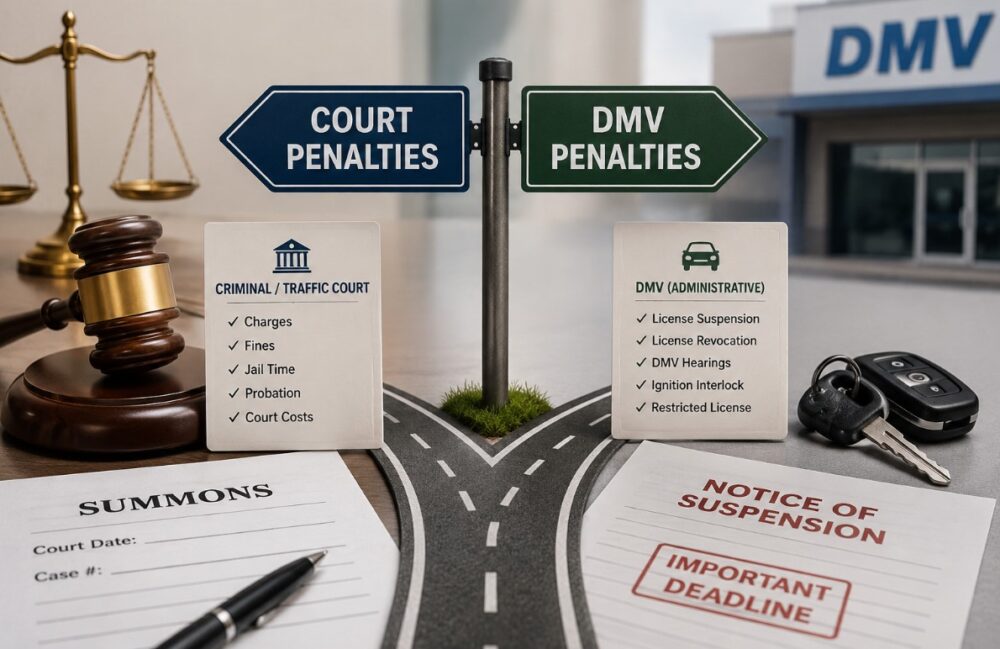
DMV penalties are administrative actions against driving privileges, while court penalties deal with criminal or traffic charges.
A DUI arrest shows the difference clearly. A driver may have one case in criminal court and another process with the state motor vehicle agency. California DMV says drivers have the right to request a DMV hearing within 10 days after receiving a suspension or revocation order, according to its DUI safety guidance. Missing a short deadline can allow an administrative suspension to move forward even while the criminal case remains open.
NHTSA also notes that impaired-driving penalties can include license revocation, fines, jail time, and legal costs. A first offense can cost upward of $10,000 in fines and legal fees, according to NHTSA drunk-driving data.
An attorney’s first job is often basic but urgent: identify every deadline, agency notice, hearing right, and court date before one missed step creates a larger problem.
When Legal Help Becomes Most Important
Legal help becomes most important when the penalty could affect a driver’s license, job, immigration record, insurance, or professional license.
A minor parking ticket usually does not require a lawyer. A notice of suspension, DUI arrest, chemical-test refusal, reckless driving charge, or CDL violation is different. Serious cases can lead to long-term record damage.
Common high-risk DMV situations include:
- DUI or drug-impaired driving allegations
- Refusal to take a breath, blood, or chemical test
- Accumulated driver’s license points
- Driving while suspended
- Reckless driving or excessive speeding
- Crash-related citations
- Medical fitness reviews
- Habitual traffic offender findings
- Commercial driver’s license disqualification
New York DMV says its point system lets the agency identify high-risk drivers, and a license may be suspended after 11 points within 24 months under the state’s driver point system. For a driver already close to that threshold, one plea decision can matter more than the ticket fine.
What Attorneys Actually Do At A DMV Hearing

Attorneys help at DMV hearings by testing whether the agency has enough lawful evidence to suspend or revoke driving privileges.
A DMV hearing is usually narrower than a courtroom trial. The hearing officer may focus on specific issues, such as whether police had lawful grounds for a stop, whether arrest procedures were followed, whether test results were valid, or whether the driver received proper notice.
An attorney may:
- Request the hearing before the deadline
- Subpoena police officers or records
- Review body-camera footage, reports, and test logs
- Challenge blood alcohol testing procedure
- Question whether notice was legally proper
- Argue for restricted driving privileges
- Preserve testimony useful in the court case
The hearing is also a fact-gathering opportunity. Even when a driver does not fully avoid suspension, testimony from an officer or gaps in paperwork can shape defense strategy in criminal court.
DMV Penalty Types And How Attorneys Respond
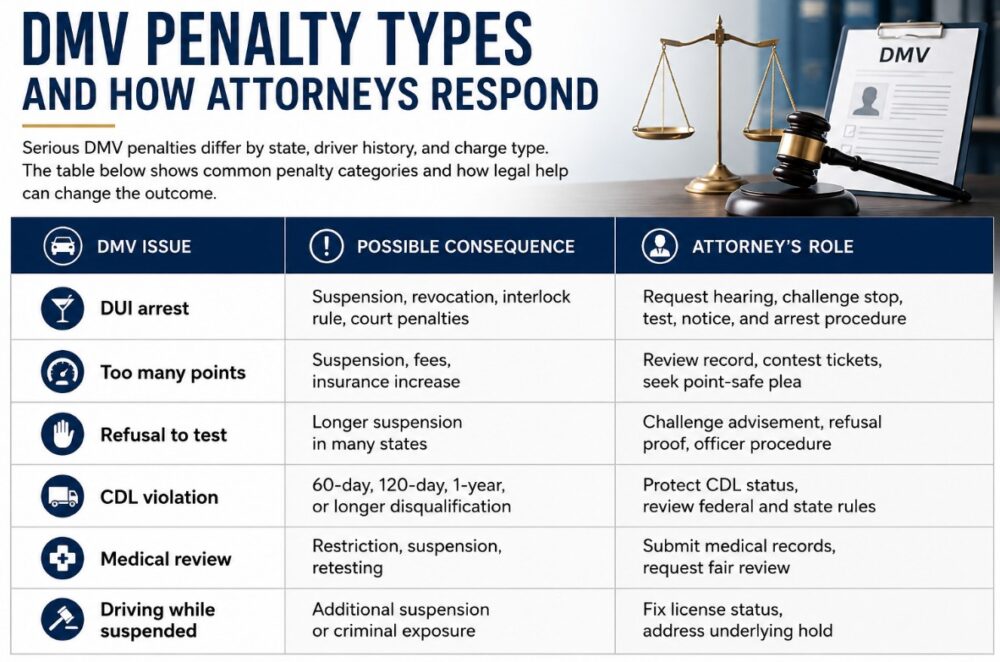
Serious DMV penalties differ by state, driver history, and charge type. The table below shows common penalty categories and how legal help can change the outcome.
| DMV issue | Possible consequence | Attorney’s role |
| DUI arrest | Suspension, revocation, interlock rule, court penalties | Request hearing, challenge stop, test, notice, and arrest procedure |
| Too many points | Suspension, fees, insurance increase | Review record, contest tickets, seek point-safe plea |
| Refusal to test | Longer suspension in many states | Challenge advisement, refusal proof, officer procedure |
| CDL violation | 60-day, 120-day, 1-year, or longer disqualification | Protect CDL status, review federal and state rules |
| Medical review | Restriction, suspension, retesting | Submit medical records, request fair review |
| Driving while suspended | Additional suspension or criminal exposure | Fix license status, address underlying hold |
In cases where the driver is accused of knowingly driving after a suspension, a suspended license attorney can review the original hold, the notice issue, and any criminal exposure before the driver makes a court decision.
CDL Drivers Face Higher Stakes
Commercial drivers face higher stakes because one DMV or traffic result can remove their ability to work.
Federal Motor Carrier Safety Administration rules treat certain violations as serious traffic violations. A second serious violation within 3 years can trigger a 60-day CDL disqualification, while a third serious violation within 3 years can trigger a 120-day disqualification under FMCSA licensing rules.
FMCSA lists serious offenses such as excessive speeding at 15 mph or more above the limit, reckless driving, improper or erratic lane changes, following too closely, and certain fatal-accident-related traffic control violations. The agency lists such violations in its commercial driver safety planner.
For CDL holders, a casual plea can be costly. Some drivers accept a traffic deal because the fine looks manageable, then learn later that the conviction creates a federal disqualification, employer reporting issue, or insurance problem. A traffic attorney with CDL experience should review the effect before any plea is entered.
How Attorneys Challenge Evidence
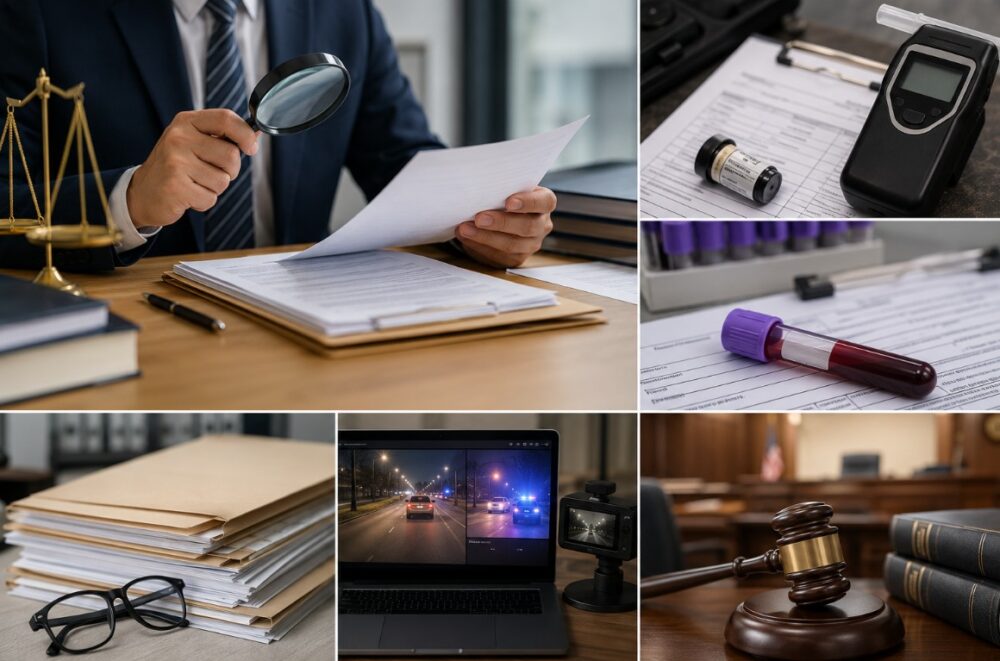
Attorneys challenge DMV penalties by looking for gaps between what the agency claims and what the record proves.
In DUI cases, evidence review may include breath-test calibration, blood draw documentation, officer training, checkpoint procedure, field sobriety test conditions, and video footage. In point cases, the focus may be conviction dates, violation codes, out-of-state reporting, prior record accuracy, and whether a traffic school or reduction option exists.
In medical review cases, a lawyer may gather updated medical opinions, treatment records, specialist letters, and evidence of safe driving. The goal is not to hide risk. The goal is to prevent an overbroad restriction when a narrower condition, retest, or medical update may address the agency’s concern.
Attorneys Also Help With Restricted Licenses
Attorneys help drivers seek restricted licenses, hardship licenses, occupational licenses, or ignition interlock options when total license loss would be severe.
Rules differ sharply by state. Some agencies allow limited driving for work, school, medical care, alcohol education programs, or family duties. Others require proof of insurance, enrollment in a treatment program, ignition interlock installation, or a waiting period.
A lawyer can help assemble a clean application packet. Key records may include proof of employment, commute distance, employer letters, school schedules, medical appointments, treatment enrollment, SR-22 or FR-44 insurance filing, and prior compliance.
The practical value is simple: even when a penalty cannot be erased, the driver may still keep a lawful path to work.
What Drivers Should Bring To A Lawyer

Drivers should bring every DMV notice, citation, court document, and insurance letter to the first consultation.
Helpful records include:
- DMV suspension or revocation notice
- Ticket or arrest paperwork
- Police report, if available
- Court date notice
- Prior driving record
- Insurance correspondence
- CDL documents, if applicable
- Employer driving requirements
- Breath or blood test paperwork
- Proof of completed classes or treatment
Guesswork wastes time. DMV deadlines can be short, so a complete document set lets the attorney act quickly.
What Attorneys Cannot Promise
Attorneys cannot promise that every suspension will be dismissed or every license will be saved.
The strongest lawyer still works inside state statutes, agency rules, court procedure, and available evidence. A driver with repeated DUI convictions, a serious injury crash, or a long record of unpaid tickets may have limited options.
A reliable attorney should explain likely outcomes in plain terms: full dismissal, reduced charge, restricted license, shorter suspension, delayed effective date, or no realistic relief. Honest risk assessment is part of good representation.
Cost Versus Risk
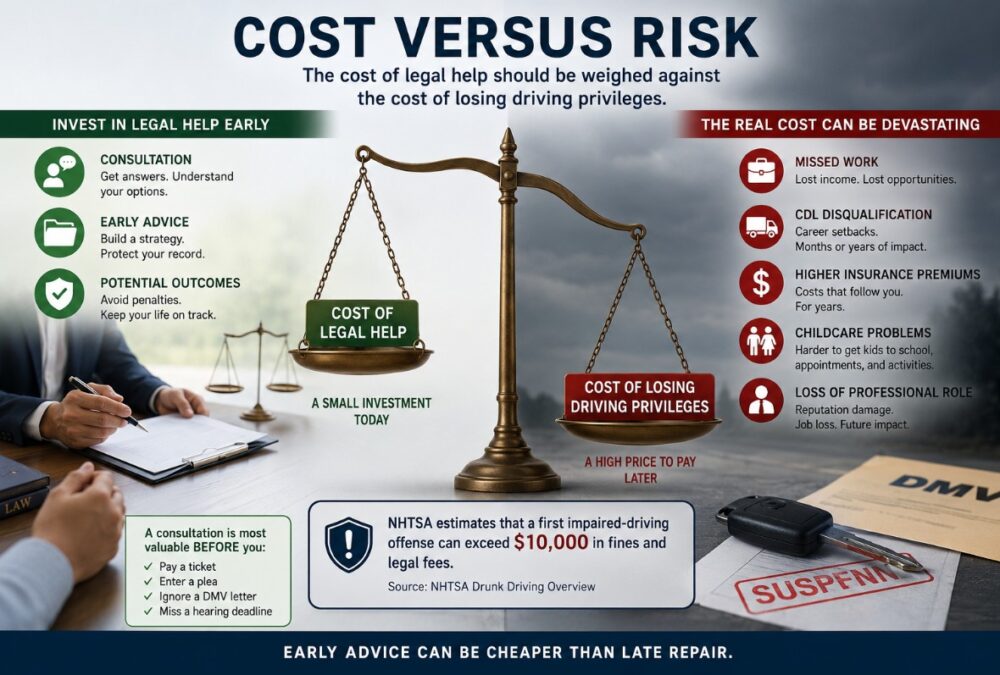
The cost of legal help should be weighed against the cost of losing driving privileges.
For some drivers, suspension means inconvenience. For others, it means missed work, CDL disqualification, higher insurance premiums, childcare problems, or loss of a professional role.
NHTSA’s estimate that a first impaired-driving offense can exceed $10,000 in fines and legal fees shows why early advice can be cheaper than late repair. The estimate appears in NHTSA’s drunk-driving overview.
A consultation is most valuable before the driver pays a ticket, enters a plea, ignores a DMV letter, or misses a hearing deadline.
Summary
Attorneys help drivers facing serious DMV penalties by protecting procedural rights, contesting weak evidence, reducing point and license consequences, and guiding drivers through separate DMV and court systems. The strongest cases are handled early, before deadlines expire and before a driver accepts a result that creates hidden license damage.
In 2026, drivers should treat DMV notices as urgent legal documents, especially after DUI, refusal, reckless driving, point accumulation, crash allegations, or CDL violations.