

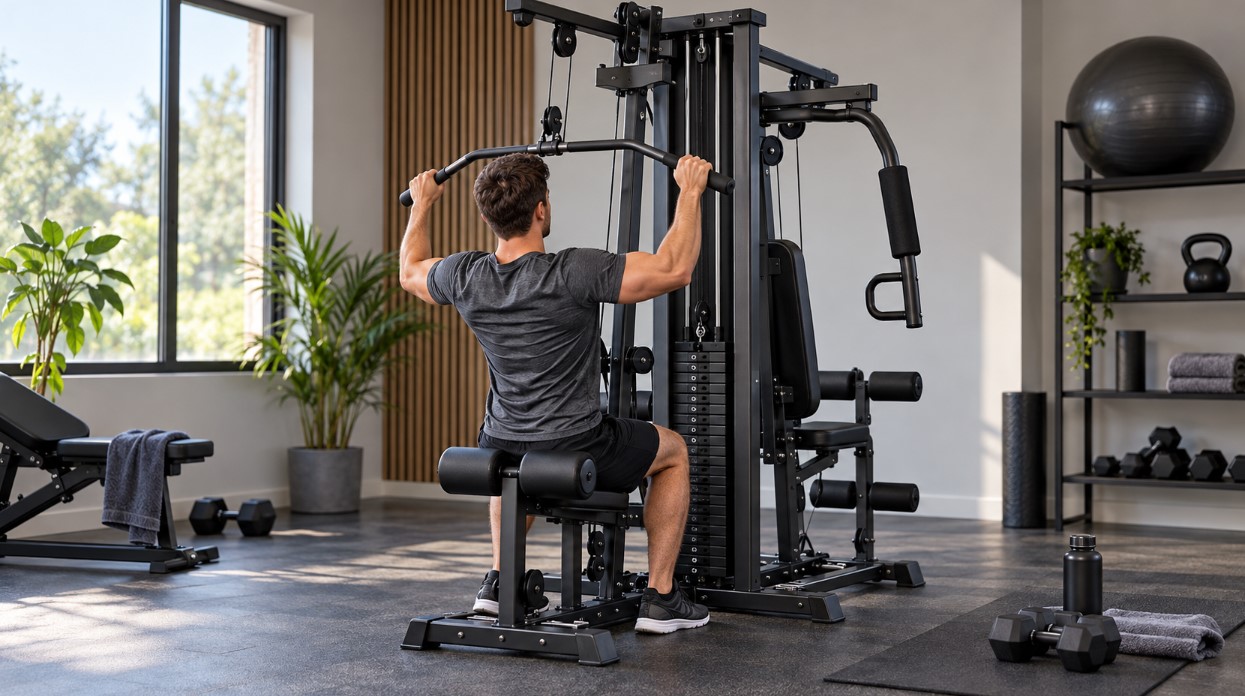
The term stack home gym gets used broadly enough that it can mean different things to different people, and if you are in the early stages of building a home gym, understanding what the equipment actually involves, how it works, and where it fits within a complete training setup will save you from buying something that does not match your actual needs.
Stack home gyms are one of the most practical and consistently underrated options in the home fitness market, and they are also one of the more frequently misunderstood.
How a Stack Home Gym Works
A stack home gym is a strength training machine that uses a guided weight stack and a pulley system to deliver resistance. The weight stack is a series of rectangular plates connected by a steel rod, with numbered increments that allow you to select your resistance level by inserting a pin through the stack at the desired weight.
The pulley system connects the weight stack to the various cable stations on the machine through a series of cables and pulleys. When you press, pull, or push against one of the machine’s stations, the cable transmits force through the pulley system and lifts the weight you selected via the pin. The movement is smooth, the resistance is consistent throughout the range of motion, and switching between weights takes about two seconds.
This is the fundamental mechanical difference between a stack home gym and free weights. With free weights, you load and unload plates, manage collars, and deal with the inertia of moving a barbell or dumbbell. With a stack gym, you move a pin. The efficiency of that difference is significant for anyone who trains with circuit workouts or supersets where the time between exercises matters.
What You Can Actually Train
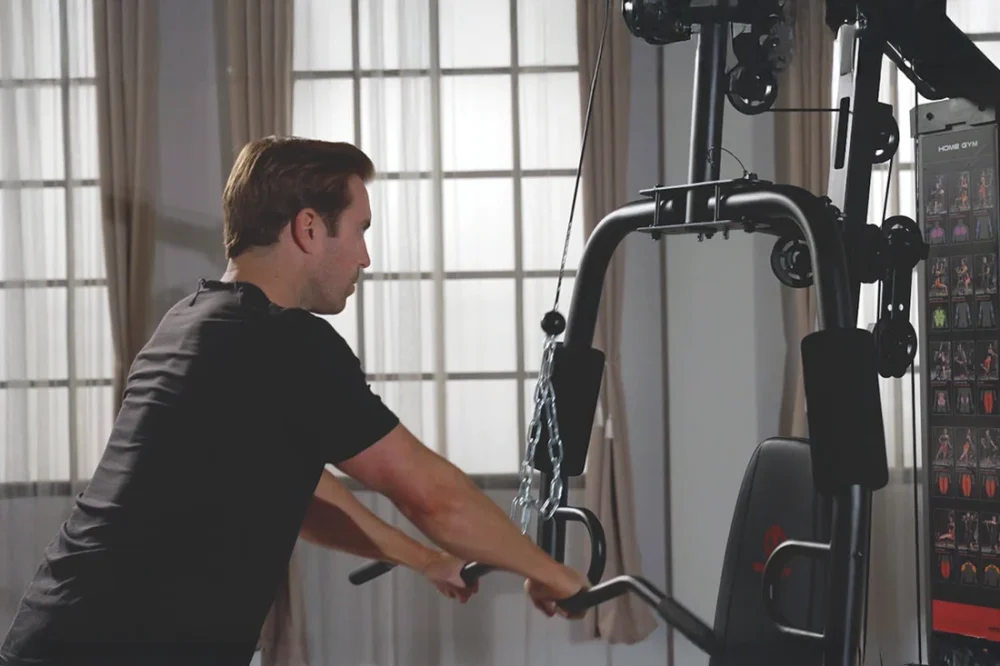
The exercise range available on a stack home gym is wider than most people assume before they use one. A machine with an overhead pulley, press arms, and an integrated leg developer covers the major movement patterns of a complete strength training program.
The overhead pulley handles lat pulldowns, cable rows, triceps pushdowns, bicep curls, and a range of shoulder exercises. The press arms allow chest press movements from a seated position that closely approximate the mechanics of a bench press. The leg developer provides leg extensions and leg curls for quad and hamstring isolation. Additional attachments like ankle straps and cable handles expand the exercise range further into hip work, core exercises, and single-joint isolation movements.
The gap between a stack home gym and a complete free weight setup is real but narrower than many people assume, particularly for the majority of exercisers whose training goals center on building strength, improving muscle tone, and maintaining fitness rather than competitive powerlifting or Olympic weightlifting.
The Practical Advantages That Matter
The advantages of a stack home gym over a free weight setup are practical rather than theoretical, and they compound over time in ways that affect how consistently the equipment gets used.
No spotter required is the first and most significant advantage for solo training. Pressing movements with a barbell require either a spotter or a rack with safety catches to train safely near failure. Stack gym press stations allow you to push close to your limit without a training partner because the guided cable system eliminates the risk of a failed rep dropping weight onto you.
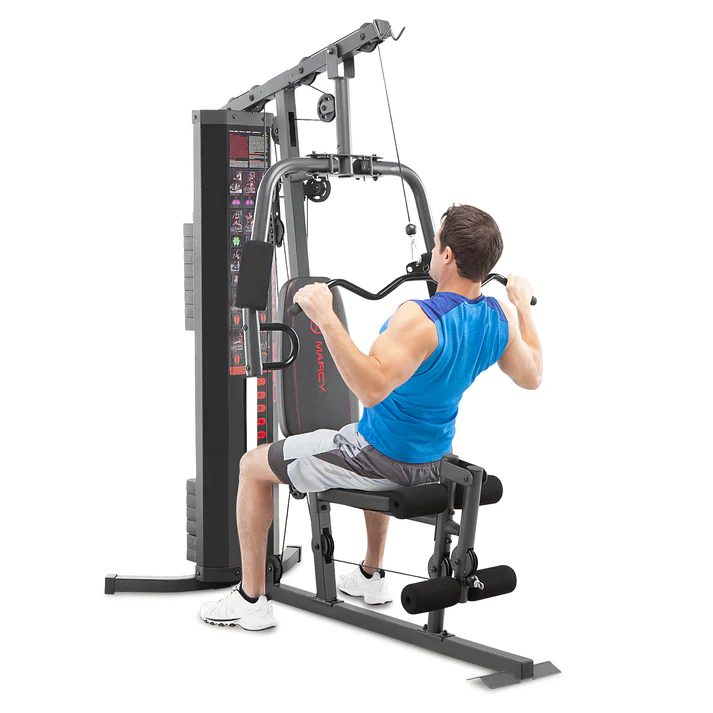
No plate management is the second practical advantage. Loading and unloading plates between exercises is a small friction point that adds up significantly across a full training session, particularly if you are training multiple muscle groups with different resistance requirements. Moving a pin eliminates that friction entirely and makes the difference between a training session that flows and one that involves constant housekeeping.
Space consolidation is the third. A stack home gym consolidates the functionality of multiple pieces of equipment into a single footprint. A lat pulldown station, a chest press station, a leg developer, and a cable column, all in one machine with one assembly and one footprint, makes a stack gym significantly more space-efficient than the equivalent collection of individual machines.
Choosing the Right Weight Stack for Your Level
The weight stack determines your resistance range, and choosing the right one for your current fitness level and where you expect to be in a year matters more than most buyers account for when selecting a model.
Marcy’s stack home gym lineup ranges from 100lb stacks at the entry level through 150lb and 188lb options in the mid-range to the 200lb Club Home Gym at the top of the line. The 150lb stack is the most versatile entry point for most exercisers, providing enough resistance for beginners to train progressively for years while also challenging intermediate lifters across most exercises.
View this post on Instagram
The 200lb Club Home Gym is the right choice for experienced lifters who regularly train with heavy loads on pulling movements, particularly lat pulldowns and seated rows where stronger backs can move substantial weight. The 100lb option suits lighter users or those specifically focused on endurance-oriented resistance training at lower loads and higher repetitions.
The principle that applies consistently across stack weight selection is to choose slightly above your current level rather than at it. A 150lb stack that you grow into over two years is a better investment than a 100lb stack you outgrow in six months and need to replace.
Where Stack Home Gyms Fit and Where They Do Not
A stack home gym is the right choice for exercisers who want a complete, safe, low-friction strength training setup in a single machine footprint, who train alone without a spotter, and who prefer the simplicity of cable-based resistance over the complexity of managing a free weight collection.
It is a less natural fit for serious barbell athletes whose training is centered on squats, deadlifts, and bench press at heavy loads that stack machines cannot replicate, and for exercisers whose primary training interest is Olympic weightlifting or powerlifting.
For the large majority of home gym users whose goals are building strength, improving body composition, and maintaining fitness through consistent training, a well-chosen stack home gym provides everything needed without anything unnecessary.