


A growing ecommerce business should build its call center around customer demand, order data, and repeatable service processes, not simply hire people to answer phones. The foundation is a cloud phone system connected to the ecommerce platform, customer relationship management software, ticketing, fulfillment data, and a searchable knowledge base. Staffing should then follow call volume, handling time, operating hours, and seasonal peaks.
The aim is to create a support operation that answers common questions quickly, routes complex cases correctly, protects customer information, and adds capacity without rebuilding the system whenever sales increase.
Start with the calls customers are already making

Before choosing software or setting a hiring target, review four to eight weeks of customer contacts. Group calls by reason, including order status, delivery delay, return request, product question, damaged item, payment problem, address change, cancellation, or pre-purchase advice. Record when each type arrives, how long it takes, and which department must resolve it.
A VoIP service provider can give the team cloud calling, interactive voice response menus, automated call distribution, custom routing, monitoring, analytics, and CRM or ticketing integrations. These tools are more useful than a basic business number because they direct calls to the correct queue and show managers where demand is building.
Decide whether the center will handle inbound support only or also make outbound calls for abandoned carts, payment recovery, retention, or sales. Outbound work needs separate scripts, consent controls, lists, and performance measures. It should not quietly take priority over customers already waiting for help.
Forecast workload before deciding how many agents to hire
Call volume alone does not determine staffing. A business receiving 300 short tracking calls has a different workload from one receiving 300 technical product calls that require research, warehouse coordination, and follow-up.
Multiply expected daily calls by average handling time, including conversation and after-call work. If the team expects 240 calls and each takes eight minutes, that produces 1,920 minutes, or 32 hours, of direct handling work.
Agents also need breaks, coaching, training, and time for unexpected problems. If one agent can provide six productive handling hours per shift, the basic requirement is 5.33 agents, so at least six must be scheduled before reserve coverage is added.
| Forecast input | What to measure | Why it matters |
|---|---|---|
| Contact volume | Calls by hour, day, campaign, and season | Demand is not spread evenly |
| Handling time | Talk, hold, and after-call work | Longer cases consume more capacity |
| Service hours | Time zones, weekends, and holidays | Longer coverage requires more shifts |
| Shrinkage | Leave, training, meetings, and absence | Paid hours are not all available for calls |
| Peak demand | Promotions, launches, and delivery disruption | Averages can hide severe overload |
Build separate forecasts for ordinary weeks and major campaigns. Temporary staff, outsourced overflow, callbacks, and extended hours can cover a predictable surge without leaving the company permanently overstaffed.
Connect the phone system to ecommerce operations

Agents should not open several unrelated systems or ask customers to repeat information the company already holds. When a call arrives, they should see the customer, recent orders, payment and shipment status, earlier conversations, and any open case.
The core stack normally includes the VoIP platform, CRM, help desk, ecommerce platform, warehouse or shipping system, returns portal, and knowledge base. A help desk ticketing system gives each request an owner, priority, status, history, and due date, preventing promised callbacks from disappearing inside inboxes or handwritten notes.
Fulfillment access is equally important. Tracking, split shipments, failed delivery, replacements, and refunds cannot be resolved from the storefront alone.
Design call flows around real customer problems
Keep the opening menu short. A useful first menu may separate order support, returns, product advice, and account or payment issues. The system can then use a phone number, order number, language, location, or account status for more precise routing.
- Send tracking questions to agents with carrier and fulfillment access.
- Route returns and damage claims to staff with refund and replacement authority.
- Direct technical product questions to trained specialists.
- Move fraud and account takeover reports to a restricted escalation team.
- Offer callbacks during long queues instead of forcing customers to remain on hold.
Write an escalation path for every category. Frontline agents must know what they can approve, when a supervisor is required, how quickly another team must respond, and who contacts the customer after a handoff. A transfer is not a resolution unless the next employee receives the full context.
Hire for judgment and train for consistency

Good ecommerce agents need more than a pleasant phone manner. They must read order histories quickly, explain policies without sounding defensive, recognize fraud warnings, write accurate notes, and remain calm when a delivery failure has already frustrated the customer.
Training should cover products, shipping, returns, discounts, subscriptions, warranties, payment handling, privacy, and each role’s authority. New hires should practice realistic calls involving missing parcels, repeated contacts, conflicting warehouse information, and requests outside policy before speaking to customers.
Create a searchable knowledge base with short answers, decision trees, screenshots, approved wording, and system links. Give every article an owner and review date. Policy changes must reach the phone team before customers discover them through a banner, email, or checkout message.
Protect payment data and prepare for outages
Call centers may handle addresses, account credentials, order histories, recordings, and payment information. Give agents only the access required for their roles. Require multi-factor authentication, strong unique passwords, current software, secure devices, and regular security training. These steps follow the practical measures in the NIST cybersecurity guidance for small businesses.
If agents accept card payments by phone, map where card data can be heard, entered, transmitted, recorded, or stored. The PCI Security Standards Council’s guidance on protecting telephone-based payment card data explains how telephone environments can fall within PCI DSS scope. Safer designs keep card numbers out of recordings and agent desktops through a secure payment page, payment IVR, or another method approved by the payment processor and compliance adviser.
Cloud calling also needs a continuity plan. The Federal Communications Commission warns that VoIP may fail during a power or internet outage. Use backup connectivity, protected network equipment, tested call forwarding, mobile failover, and documented emergency contacts.
Recording and monitoring laws differ by country and, in the United States, by state. Obtain legal advice on consent notices, retention periods, employee monitoring, and cross-border transfers before enabling automatic recording.
Set rules for outbound sales and follow-up calls
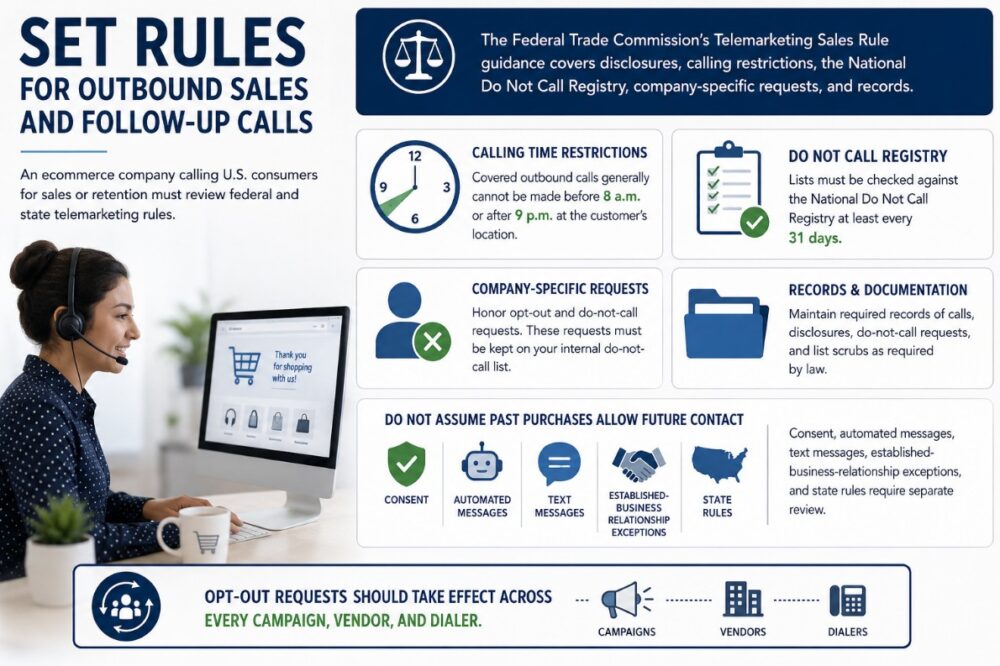
An ecommerce company calling U.S. consumers for sales or retention must review federal and state telemarketing rules. The Federal Trade Commission’s Telemarketing Sales Rule guidance covers disclosures, calling restrictions, the National Do Not Call Registry, company-specific requests, and records. Covered outbound calls generally cannot be made before 8 a.m. or after 9 p.m. at the customer’s location, and lists must be checked against the national registry at least every 31 days.
Do not assume that an earlier purchase permits every future campaign. Consent, automated messages, text messages, established-business-relationship exceptions, and state rules require separate review. Opt-out requests should take effect across every campaign, vendor, and dialer.
Measure whether the call center is solving problems
Track speed of answer, abandonment, first-contact resolution, repeat contacts, transfer rate, average handling time, after-call work, quality scores, customer satisfaction, cost per contact, and call revenue when sales are part of the operation.
Read the measures together. Lower handling time can look efficient while repeat calls and refunds rise because agents are ending conversations too quickly. A strong first-contact resolution rate matters only if quality reviews show the answer was correct. The approach in Kiwibox’s article on using data analytics to improve operations applies here: connect every measurement to a decision about staffing, routing, training, policy, or technology.
Review call reasons weekly during launch. Repeated contacts often reveal a problem outside the call center, such as unclear product descriptions, late tracking updates, confusing return rules, packaging failures, or a checkout error. Fixing the original cause reduces demand and improves service at the same time.
Launch with a controlled pilot and expand from evidence
- Map the operation: Map call reasons, volumes, escalation paths, and legal requirements.
- Configure the systems: Configure numbers, queues, routing, integrations, permissions, and reports.
- Prepare the team: Write the knowledge base and train a small first group.
- Test critical scenarios: Test ordinary calls, payment issues, outages, and peak queues.
- Run a pilot: Launch with limited traffic, review results daily, and correct failures quickly.
- Expand gradually: Add agents, languages, regions, and outbound campaigns after the core service is stable.
A call center becomes scalable when more orders do not automatically create confusion. The company should know why customers call, what each agent can do, where every case is recorded, how sensitive data is protected, and which measurements trigger a staffing or process change. With that foundation, adding capacity becomes a planned operating decision rather than an emergency response to the next promotion or holiday rush.