

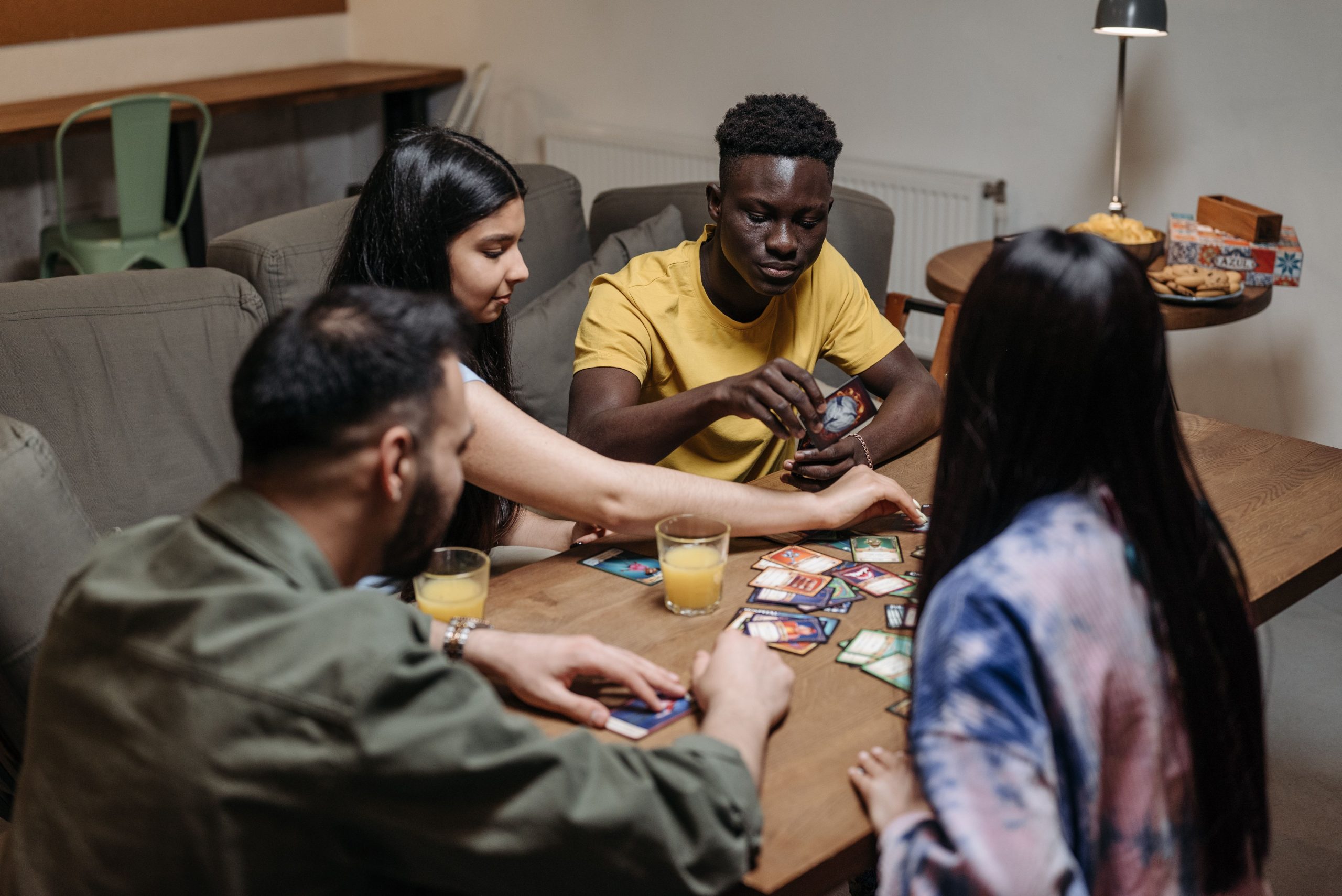
Every game-night crew hits the same wall. The deck-shedding game everyone has memorized stops producing surprises, and the winner starts being decided by whoever gets bored last. The fix isn’t a new box with four hundred pieces. It’s a card game nobody at the table grew up with, because the part that doesn’t translate is exactly the part that stays interesting: a rule that rewards the lowest hand instead of the highest, a signal you’re allowed to flash at your partner, or one card the whole table quietly watches for.
Card games aren’t the niche their reputation suggests, either. A May 2026 YouGov poll of 1,131 U.S. adults put standard card games at about 25% of Americans who play them at least once a month. Mobile games pull roughly 56% at that frequency, so the honest headline is that phones win. But card games hold the ground phones can’t: they cost one deck, they work when the power is out, and everyone at the table is actually looking at each other.
My bias, declared up front: if your group has exactly three people and one open evening, I don’t think there is a better game here than Tongits. And I’d argue Belote is the most underrated of the five, mostly because almost no one outside France has ever been taught it.
Here are the five, what makes each one worth learning, and how to run them without turning game night into a rules seminar.
The five games, side by side
Start here. The single fact worth noticing in the table is how different the win conditions are. Three of the five reward the lowest score or the last cards out rather than the most tricks, which is why they feel nothing like the games most English-speaking households know.
| Game | Home | Players | Deck | How you win |
|---|---|---|---|---|
| Tongits | Philippines | 3 | Standard 52 | Empty your hand, or hold the fewest points when the central pile runs out |
| Truco | Spain, Argentina, Brazil | 2, 4 or 6 | 40-card Spanish (French in some Brazilian variants) | First team to 30 points; 12 in the Brazilian Paulista version |
| Scopa | Italy | 2, 3, 4 or 6 | 40-card Italian | Capture cards and score; first to 11 points |
| Belote | France | 4 | 32-card piquet | Win tricks and melds; first team to 1,000 points |
| Skat | Germany | 3 | 32-card | As declarer, take at least 61 of the 120 card points |
Player counts, deck sizes and scoring targets above follow the standard descriptions on each game’s Wikipedia entry, checked in October 2026. Regional house rules vary more than you’d expect, so the table is a starting point, not a contract.
Tongits: the Filipino rummy game that earns top billing
Tongits (also spelled Tong-its) is a three-player rummy game that took hold in Luzon in the 1990s and has since spread across the Philippines and into every diaspora community with a flat surface and a deck. It uses a standard 52-card pack. Every player is dealt twelve cards, the dealer gets thirteen, and the rest sits in a central pile. Aces count as one point, face cards are worth ten, and everything else keeps its printed value.
You win in one of two ways. Either you get rid of your last card and call “Tongits,” or the central pile runs dry and the player holding the fewest points takes the round. That low-score ending is the first thing that surprises newcomers, and it’s what makes the last few turns tense in a way most shedding games aren’t.
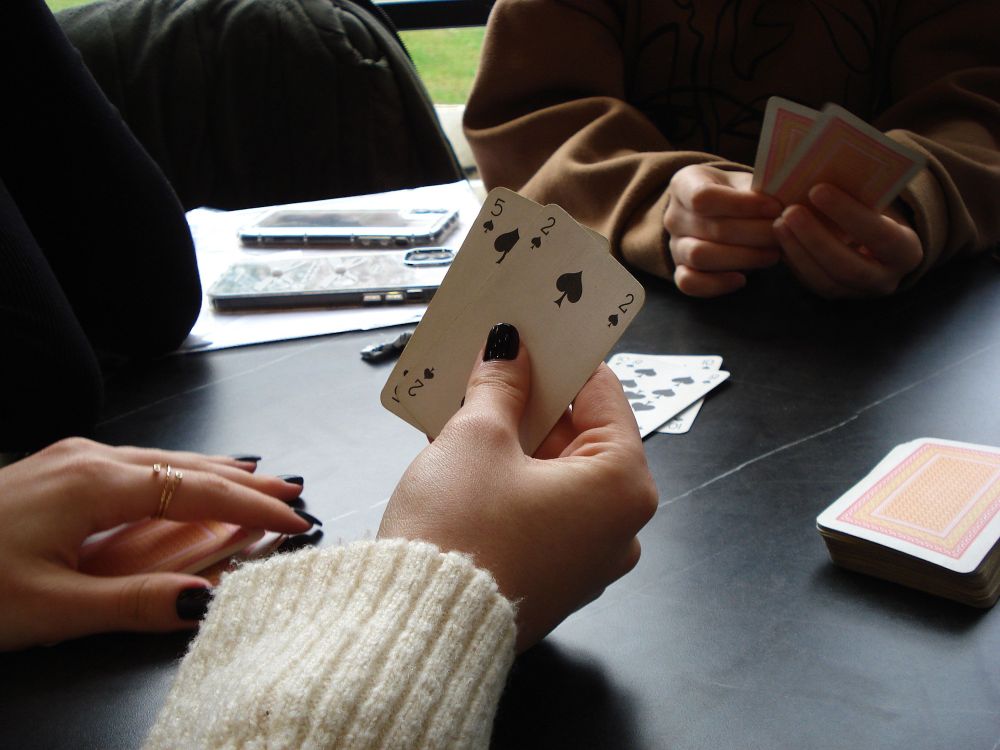
Melds are three of a kind or a same-suit run. You can also “sapaw,” the move that lets you bolt a fourth card onto a meld an opponent has already laid down, which means an exposed hand is never truly safe. A player who never exposes a meld at all is “burned,” or sunog, and loses automatically. There are special hands with their own names too, including the four-of-a-kind “secret” and a “spread” that can win a round before play even starts.
The low-point finish and sapaw turn what is usually a solitary game into a negotiation. You are watching three hands at once, not just your own, and the decision to hold a meld back instead of playing it is a real gamble. I rate it above the other rummy variants for exactly that reason. If you want to learn it by playing rather than reading a rule sheet, the gamezone tongits tables run the standard three-player format against live opponents, which compresses the learning curve for draw and sapaw calls considerably. GameZone is a commercial, PAGCOR-licensed platform operated under DigiPlus Interactive, so it is a real-prize environment for adults rather than a free practice app.
Tongits also happens to be the one game on this list with a genuinely modern diaspora story. When developer Eric Asinas turned the street game into a Facebook app, he told GMA News that for overseas Filipino workers, Tongits sat alongside karaoke and basketball as one of the things they missed most. “And that is Tongits, our most popular card game,” he said. The Facebook version drew 1.4 million users before server costs forced it offline in 2013, and the rebuilt mobile game passed 500,000 downloads by late 2016. Card games don’t need a marketing budget when the game itself is the memory.
Truco: where the talking is half the game
Truco is a trick-taking game that started in Valencia and the Balearic Islands and found its true home in South America. Argentina and Brazil treat it less like a pastime and more like a local dialect. It uses a 40-card Spanish deck in most places, and in the Brazilian Paulista version the four trump cards are decided by flipping an extra card after the deal, which can turn a hopeless hand into an unbeatable one between one turn and the next.
The scoring is where it stops resembling anything in an American living room. You can bid, bluff and re-raise the value of a round with “truco,” “retruco” and “vale cuatro.” Partners are allowed a formal set of hand signals, called señas, to tell each other which strong cards they hold. In other words, the game openly permits the table talk that most rule books spend a page banning.
That makes Truco a good test for a group. If your friends fold quietly and avoid confrontation, it will fall flat. If they argue about the rules for twenty minutes and enjoy it, Truco is the game they’ve been waiting for. Play to 30 points in the Argentine version, or to 12 in the Brazilian one, and expect the bidding to be louder than the cards.
Scopa: the broom, the seven of coins, and a century of table talk
Scopa is a fishing game from Italy, usually played with a 40-card Italian deck split into cups, coins, swords and clubs. On your turn you either place a card on the table or use a card from your hand to capture a matching card, or a set of cards that adds up to your card’s value. Clear the whole table in one move and you’ve made a scopa, Italian for “broom,” which is worth a bonus point and a small amount of gloating.
The card to care about is the seven of coins, the settebello. It feeds all four of Scopa’s scoring categories at once, which makes it the most valuable single card in the deck and the reason experienced players will sacrifice a whole round’s tempo to grab it. Games run to 11 points, and yes, the banter is traditionally part of the experience rather than a sign that something has gone wrong.
Belote: France’s national card game that almost no tourist learns
Belote uses 32 cards and four players in fixed partnerships, and it has a quirk that throws every new player at first: in the trump suit, the jack and the nine outrank the ace. Get past that and it’s one of the most satisfying partnership games going. It appeared in France around 1900, and its official rules were first published in 1921. A “belote” is a king and queen of trump held together, worth 20 points, which is where the game gets its name. You take tricks, declare sequences and four-of-a-kinds, and the first team to 1,000 points wins.
The game spread outward and changed names along the way: it’s called baloot in Saudi Arabia, pilotta in Cyprus, and klaverjassen in the Netherlands, which tells you how well the basic structure travels. This is the one I’d push hardest on a group that already likes Bridge or Euchre. It rewards the same partnership instincts, but the jack-nine trump order and the belote declaration give it a distinct feel, and four players is exactly the size of most game nights anyway.
Skat: the German game organized like a sport
Skat was devised around 1810 in Altenburg, in what is now Thuringia, and it is the national card game of Germany. Three players, 32 cards, and a bidding phase that decides which of you plays alone against the other two. The declarer has to take at least 61 of the 120 available card points.
What separates Skat from the other four is the infrastructure around it. It is run as an organized sport, with clubs, ranking lists, a national league, and world and European championships. The German Skat Association estimates that around 25 million Germans play the game, a number that should make anyone who assumed card games were fading stop and reconsider. The word itself comes from the Latin scarto, meaning to discard, a decent description of the two cards set aside before play. Bidding adds a layer of arithmetic that scares people off, but the game’s three modes, suit, grand and null, mean a bad hand is rarely a wasted hand.
The counterargument: is this just nostalgia?
There’s a fair case against everything above, and it’s worth stating properly. The same YouGov data that shows card games holding steady shows mobile games at more than double that monthly rate, and modern designer board games have spent two decades getting better at the thing card games take for granted: onboarding. A game like Catan or Ticket to Ride teaches itself through the board, while a trick-taking game asks you to hold an escalating scoring system in your head while you play.
My read is that this comparison gets the job backwards. Card games and board games aren’t competing for the same slot. A board game is an event you plan; a deck of cards is what you do when four people are already in the room and nobody wants to set anything up. The evidence that the format is alive isn’t nostalgia at all, it’s the migration online: Tongits went from street corners to 1.4 million Facebook users to a half-million-download mobile game, and the reasons people play it there are the same reasons they played it in person.
How I’d actually run a five-game night
Do not teach all five in one sitting. That’s the fastest way to spend an evening reading rules aloud and none of it playing. Here’s the sequence I’d use instead.
- Pick two games, not five, and only one that requires partnership logic. Tongits and Scopa make a good first pair because both use a familiar 40-to-52 card deck and neither depends on a partner.
- Deal the first hand face-up. Let everyone see what a good and bad starting position looks like before the real game begins. It costs one round and saves half an hour of confused questions.
- Announce the win condition before the cards, because “lowest score wins” and “take the most tricks” are opposite instincts and players will default to the wrong one.
- Agree the house rules out loud, especially in Skat and Truco, where regional variations are the norm rather than the exception.
- Save Belote and Skat for groups of exactly four and three. Both are sharply tuned to their player count, and forcing them to fit the wrong number of people is where fun goes to die.

Frequently asked questions
Which of these games is best for a total beginner?
Scopa. Capturing cards by matching value or sum is intuitive, the scoring is only a handful of categories, and a round takes minutes rather than an evening.
How many people do I need for each game?
Tongits and Skat work best with exactly three. Belote needs four. Scopa and Truco flex between two and six, though Truco at its best is a partnership game.
Do I need special cards?
Only for Truco and Scopa, which traditionally use Spanish and Italian 40-card decks. Both can be adapted to a standard 52-card pack by removing the eights, nines and tens, though purists will complain about the Italian suits.
Which game is best for a group that likes trash talk?
Truco, without contest. The betting ladder and the sanctioned hand signals are designed to reward confident bluffing and loud negotiation.
Can you play Tongits with two players?
The standard game is built for three, and the draw and challenge rules assume a third opponent. Most serious players treat three as the real number rather than a preference.