


Two people can own the exact same phone, live on the same street, and still play games in ways that barely resemble each other. One opens an app on the bus, plays for ninety seconds, and closes it before their stop. The other sits down after dinner and doesn’t look up for three hours. Neither is doing it wrong. But the gap between them is bigger than “some people have more free time,” and the data on how people actually play makes that pretty clear.
The five-minute default and the six-hour outlier

Start with what actually gets measured. According to the 2026 Mobile & PC Gaming Benchmarks report, the median mobile game session in 2025 ran between 3.1 and 3.5 minutes.
Even the top 10% of mobile games, the ones doing everything right by engagement standards, only pushed players to around 8 minutes per sitting.
PC tells a completely different story: median session length sits around 18 minutes, the top quarter of games regularly exceed 30 minutes, and the top 1% of titles blow past 100 minutes in a single sitting.
| Platform / segment | Typical single-session length | Source period |
|---|---|---|
| Mobile, median (P50) | 3.1–3.5 minutes | 2025 |
| Mobile, top 10% of games (P90) | ~8 minutes | 2025 |
| Mobile, top 1% of games (P99) | 22–24 minutes | 2025 |
| Mobile casino/card genre, Europe | up to 25 minutes | Q1 2024 |
| PC, median (P50) | ~18 minutes | 2025 |
| PC, top 25% of games (P75) | 30+ minutes | 2025 |
| PC, top 1% of games (P99) | 100+ minutes | 2025 |
Figures compiled from GameAnalytics/InvestGame’s 2026 Mobile & PC Gaming Benchmarks and the earlier Q1 2024 mobile benchmark release; both current as of their publication dates.
Notice the outlier row: mobile casino and card games routinely beat the mobile average by a wide margin, closer to PC territory than to the hyper-casual games sitting next to them on the same app store.
That single row is a clue that platform alone doesn’t decide session length. Genre and personal goals matter at least as much.
What’s happening in your head after minute twenty-five
The people who lose hours to a game aren’t necessarily more disciplined or more addicted than everyone else; a lot of what’s happening to them is measurable. Research on flow states, the “in the zone” feeling of total absorption Mihaly Csikszentmihalyi first described in the 1970s, keeps turning up a strikingly consistent number.
In one frequently cited experiment, a comprehensive review of flow research in gaming notes that flow tends to peak only after about 25 minutes of continuous play, once a player has fully shifted from consciously thinking through controls to acting on near-automatic skill.
Cut the session short at minute ten and you never get there.
That’s a real, physiological reason a long-session player might find a five-minute mobile round unsatisfying no matter how well designed it is: they’re being interrupted right before the payoff.
I think this is the piece most “just make it shorter” advice misses. Short sessions aren’t a worse version of long sessions; they’re optimized for a completely different kind of reward, one built on quick feedback loops instead of sustained immersion.
Judging one by the other’s standard is like complaining a sprint doesn’t have the scenery of a marathon.
It’s not really about time. It’s about what you’re trying to get out of the game
A 2024 framework called the DEEP model, built from factor analysis of how 750 players rated their interest in different in-game actions, breaks player motivation into four dimensions: Discovering, Experimenting, Expanding, and Performing.
The researchers then had a language model annotate 16,000 games against those dimensions and found clean genre patterns.
Role-playing and strategy games score high on Expanding, the drive to build out a persistent world or system, which is exactly the kind of goal that resists being wrapped up in five minutes.
Puzzle, racing, and sports genres score low on Discovering and Expanding but line up with Performing, which is inherently well suited to short, complete, scoreable bursts.
Put plainly: if what you want from a game is to build something that keeps growing, a five-minute session feels like being handed a shovel and told to dig a basement before your lunch break ends.
If what you want is a clean win-or-lose result you can walk away from satisfied, a long open-world session just delays the part you actually came for.
Depth is not a design failure, and short sessions are not a cop-out

There’s a long-running argument inside game design about which side deserves more respect.
In a widely discussed 2013 piece, a designer at mobile studio Quark Games pushed back hard against the industry’s obsession with 5–7 minute sessions, arguing that “a hardcore user is willing to trade flexibility for immersion” and that the studio’s own PvP strategy game, Valor, was built around 30-minute-plus sessions on purpose, because “you don’t watch Lord of the Rings in five-minute spurts.”
That piece is over a decade old now, but the tension it describes hasn’t gone away: most modern mobile design guidance still centers on what one recent industry guide calls “micro-sessions,” tightly scoped 1-to-5-minute loops built for commutes and coffee breaks.
My honest read is that both camps are right about the audience they’re serving and wrong when they generalize past it. Micro-session design is genuinely the correct call for someone with three minutes between meetings.
It is also, by design, incapable of delivering the kind of slow-burn investment that makes people name their characters after real friends or spend a weekend optimizing a base layout.
Neither failure mode is a flaw; they’re trade-offs, and pretending one approach should win everywhere is where a lot of design arguments go wrong.
Your calendar decides more than your personality does
Preference and circumstance get tangled together more than people admit. A mixed-methods study presented at the 2026 CHI conference tracked logged Xbox playtime and wellbeing over three months and found that work-related stress, physical illness causing fatigue, and social strain all reduced both playtime and wellbeing at the same time, while self-improvement goals were linked to lower playtime alongside higher wellbeing.
In other words, someone who “prefers” quick sessions this month might just be exhausted, not naturally a short-session person.
A separate economics paper studying a multi-generational franchise game found something almost the opposite for the players who do get to play a lot: roughly 27% of players turned out to be inherently more competitive, and because competitive modes build skill faster than casual ones, that group spent progressively more time playing and settled into their true preferences faster than everyone else.
Preference, in other words, isn’t always something you arrive with.
Sometimes it’s something you discover by playing enough to find out.
Where does that leave the two people from the opening paragraph? If I had to bet, the commuter isn’t necessarily a “casual gamer” for life, and the three-hour player isn’t necessarily incapable of enjoying something shorter.
Life circumstance decides more of this split than personality does, at least in a given season. That’s worth remembering before anyone gets labeled a “real gamer” or not one, based purely on how long their sessions run this year.
Where quick-spin games sit in the middle of all this
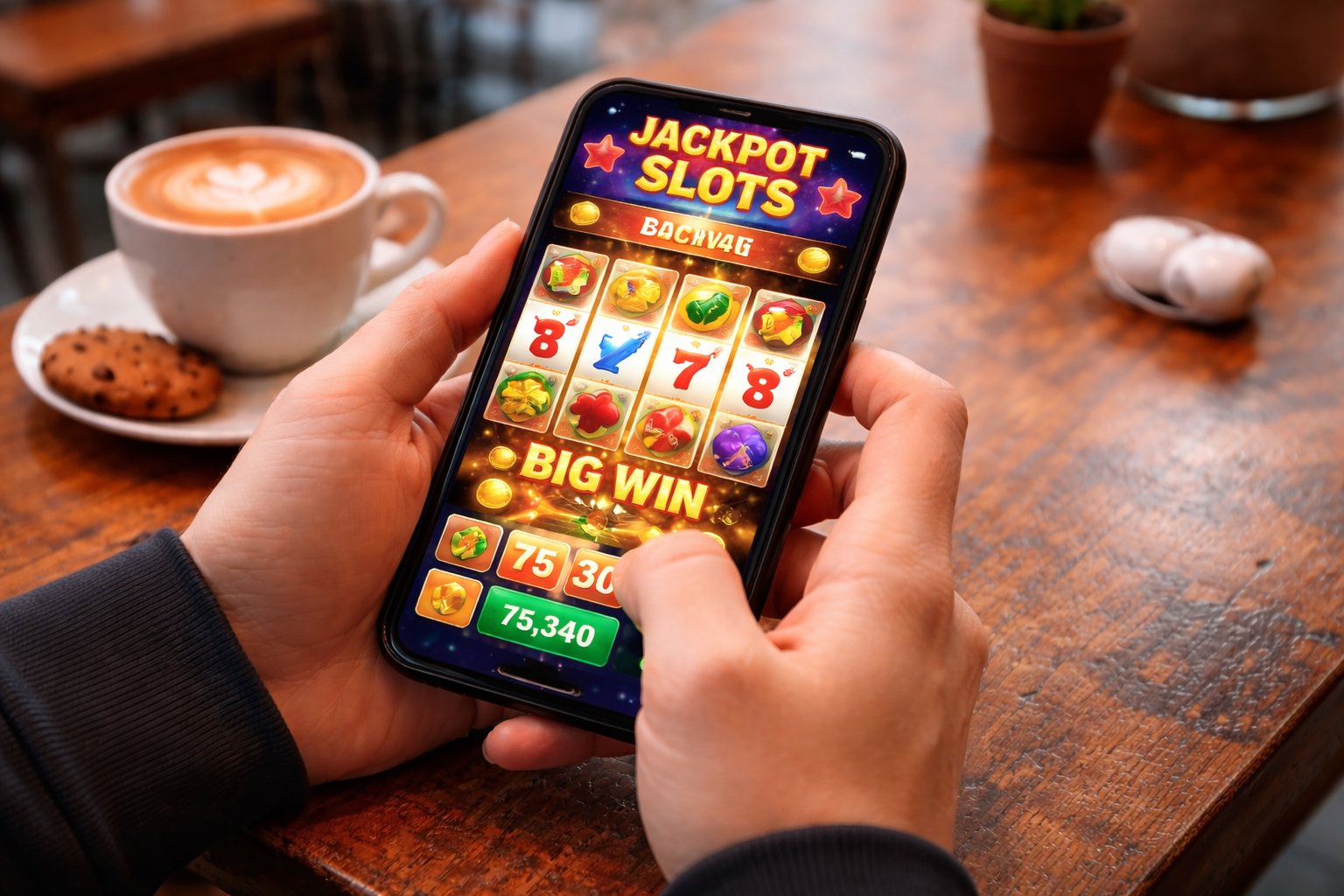
Slot and casino-style games are an interesting test case precisely because they don’t pick a side. The mechanic itself, spin, result, spin again, is built for a single-round loop that can end whenever the player wants, which is why casual players can treat it exactly like any other quick mobile game: a few rounds during a break, then gone.
But the Q1 2024 benchmark data above showed mobile casino and card titles pulling median sessions of 15 to 25 minutes depending on region, closer to PC numbers than to hyper-casual mobile games.
That’s the same DEEP-model pattern from earlier showing up again: bonus rounds, progressive jackpots, and game variety give players who want to stay a genuine reason to keep spinning rather than close the app.
Someone browsing slots in the Philippines can play the exact same title as a five-minute filler or a much longer sit-down session, and the format doesn’t punish either choice. Few genres are built with that much tolerance for both crowds at once.
So here’s a genuine question worth sitting with: if a single game format can comfortably serve both the person with three minutes and the person with three hours, why do so many other games still force players to pick a lane?
I don’t think it’s laziness on the developer’s side so much as most game loops genuinely can’t flex that way without breaking their own pacing. Slots get away with it because the core loop is short by nature and depth is layered on top, rather than depth being the loop itself.
Frequently asked questions
What is the average video game session length?
It depends heavily on platform. Mobile games median out at around 3 to 4 minutes per sitting as of 2025, while PC games median closer to 18 minutes, with the longest-running titles on either platform stretching far past those averages.
Why do mobile games feel so much shorter than console or PC games?
Partly device context (people play mobile games during commutes, breaks, and downtime) and partly deliberate design: most mobile studios build around “micro-session” loops of 1 to 5 minutes so the game fits into fragmented free time rather than demanding a dedicated block of it.
Is playing in short bursts worse for you than long sessions?
Not according to the research so far. Studies looking at wellbeing and playtime consistently find that raw session length alone isn’t a meaningful predictor of wellbeing; what a player does during play and why they’re playing (stress relief versus compulsive obligation) matters far more than the clock.
Do slots and other casino-style games favor short or long sessions?
Both, which is somewhat unusual. The core spin-and-result loop supports quick, self-contained rounds, but bonus features and game variety give players who want to keep going a real reason to settle in, which is why benchmark data shows casino and card games running noticeably longer average sessions than most other mobile genres.
Can someone’s preference for quick or long sessions change over time?
Yes. Research following players across multiple game generations found that people often don’t know their true preference until they’ve played enough to discover it, and life circumstances like work stress or illness can shrink someone’s available session length without changing what they’d actually choose if they had more time.
How this article was put together
This piece leaned on published mobile and PC session-length benchmarks from GameAnalytics/InvestGame (2024 and 2026 reports), peer-reviewed and preprint research on flow states, player motivation (the DEEP model), and gaming wellbeing, plus a 2026-published economics paper studying multi-generational player behavior and a widely cited 2013 game-design essay representing the “depth over accessibility” side of an ongoing industry debate.
All figures cited are attributed to their original report period rather than presented as universal or permanent numbers; session-length benchmarks in particular shift from year to year and are worth rechecking against the latest GameAnalytics release before quoting them elsewhere.