


Workplace safety training in 2026 means giving employees clear, job-specific instruction before exposure to hazards, then refreshing it whenever tasks, equipment, chemicals, worksites, or legal duties change.
For U.S. employers, OSHA requires training for workers who face job hazards, and several OSHA standards contain specific training duties. A generic video, a signed attendance sheet, or an OSHA 10 card alone is not enough when employees face real hazards on a shop floor, jobsite, warehouse, clinic, restaurant, or office.
The stakes remain concrete. Private industry employers reported 2,488,400 nonfatal workplace injuries and illnesses in 2024, while U.S. workplaces recorded 5,070 fatal work injuries in the same year. Both figures were lower than 2023, but they still point to preventable human harm, downtime, claims, inspections, turnover, and legal exposure.
Why Workplace Safety Training Still Matters in 2026
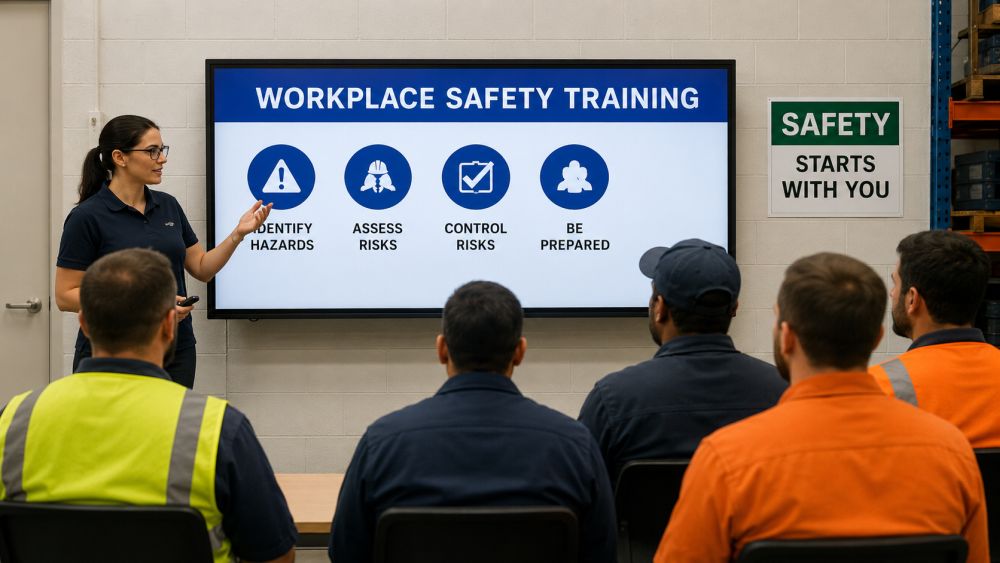
Workplace safety training matters because it connects legal compliance with day-to-day behavior. A fall-protection policy in a binder does not stop a roofer from stepping near an unprotected edge. A chemical label does little for a night-shift cleaner who cannot read the warning or has never been shown how to use gloves, ventilation, or eyewash.
OSHA’s safety management guidance stresses a proactive approach: find and fix hazards before a worker gets hurt, rather than reacting after an injury, inspection, or new rule.
That point matters for small and mid-sized employers because safety training often becomes the place where management discovers weak spots: outdated procedures, missing guards, rushed onboarding, poor supervision, or contractors working under different rules.
In 2026, the business case is also sharper. OSHA penalties remain high. The Department of Labor said it made no 2026 inflation adjustment because required October 2025 CPI-U data was unavailable, so the 2025 OSHA maximums still matter: $16,550 per serious violation and $165,514 per willful or repeated violation, according to the Federal Register notice.
What Must Employers Train Workers On?
Employers must train workers on the specific hazards they can reasonably encounter in their actual jobs. OSHA does not use one universal training checklist for every workplace.
Instead, training duties appear across standards for areas such as hazard communication, fall protection, lockout/tagout, powered industrial trucks, respiratory protection, bloodborne pathogens, confined spaces, excavation, and personal protective equipment.
A practical training map should start with job tasks, not course titles.
| Workplace situation | Training focus | Human consequence if ignored |
| New warehouse hire drives a forklift | Powered industrial truck operation, site traffic rules, pedestrian zones | Collision risk, product damage, worker injury |
| Maintenance employee services machinery | Lockout/tagout, stored energy, verification steps | Amputation, crushing, fatal startup event |
| Cleaner handles chemicals | Hazard communication, labels, Safety Data Sheets, PPE | Burns, respiratory exposure, chemical mixing incident |
| Roofer or installer works at height | Fall hazards, anchor points, ladders, rescue planning | Serious fall injury or death |
| Clinic worker handles blood or sharps | Bloodborne pathogens, exposure response, waste handling | Infection exposure and reporting failure |
For healthcare settings, employers may also need role-specific emergency response instruction, especially where staff are expected to respond before outside help arrives. In those cases, Basic Life Support (BLS) can be relevant for workers who need healthcare-level CPR and cardiovascular emergency response skills.
Training also has to match real comprehension. OSHA policy says required employee training must be delivered in language and vocabulary employees can grasp. If workers do not comprehend English well enough, English-only training will not satisfy the obligation.
Is OSHA 10 or OSHA 30 Enough?
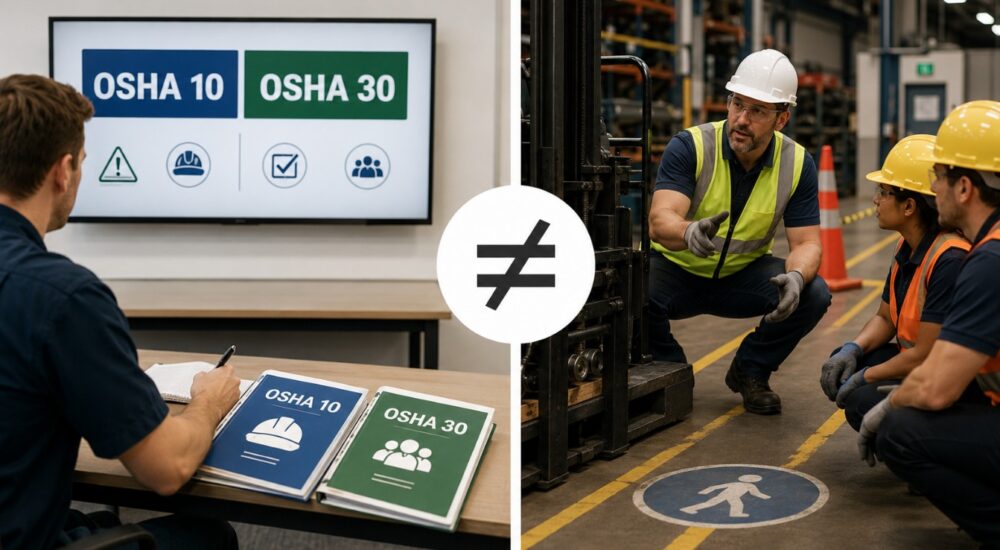
No, OSHA 10 or OSHA 30 is useful awareness training, but it does not replace hazard-specific employer training required under OSHA standards. OSHA says its Outreach Training Program gives basic and more advanced instruction on common job hazards, but it does not fulfill an employer’s duty to provide training under specific OSHA standards.
OSHA also states Outreach courses are voluntary at the federal level, although some states, municipalities, unions, owners, or contractors may require them.
That distinction is often missed. OSHA 10 can help a new construction worker recognize common hazards. OSHA 30 can help a supervisor think more broadly about responsibility.
Neither proves that a worker knows your trench plan, your forklift routes, your chemical inventory, your machine-specific lockout steps, or your emergency evacuation route.
For employers, the safer approach is simple: use OSHA 10 or OSHA 30 as a foundation, then add site-specific, task-specific, and equipment-specific training.
How Often Should Safety Training Be Refreshed?
Safety training should be refreshed whenever risk changes, performance slips, a rule requires renewal, or an incident shows a knowledge gap. Some standards have defined intervals. Others require retraining after changes in workplace conditions, new hazards, unsafe operation, or employee performance concerns.
A calendar-only approach can fail. Annual refresher training has value, but a worker moved from packing to powered equipment needs training before assignment, not at the next yearly meeting. A contractor crew arriving for 3 days still needs orientation before entering areas with traffic, chemicals, energized systems, or fall hazards.
Useful triggers include:
- New hire or temporary worker onboarding
- Job transfer or new equipment
- New chemical, process, or worksite
- Incident, near miss, or unsafe observation
- OSHA citation, insurance audit, or client requirement
- Return after long absence from a high-risk task
What Employers Usually Miss
Employers often miss verification. They document that training happened, but they do not confirm that workers can apply it under real conditions.
A signed roster proves attendance. It does not prove competence. For low-risk topics, a short quiz may be enough. For forklift operation, fall arrest inspection, lockout/tagout, respirator fit, or emergency response, workers need hands-on demonstration, supervisor observation, and correction. ISO 45001, the international occupational health and safety management standard, treats training and competence as part of a larger safety system rather than isolated paperwork.
The overlooked question is not “Did the employee sit through training?” It is “Can the employee do the task safely when production pressure rises?”
How to Build a Workplace Safety Training Program
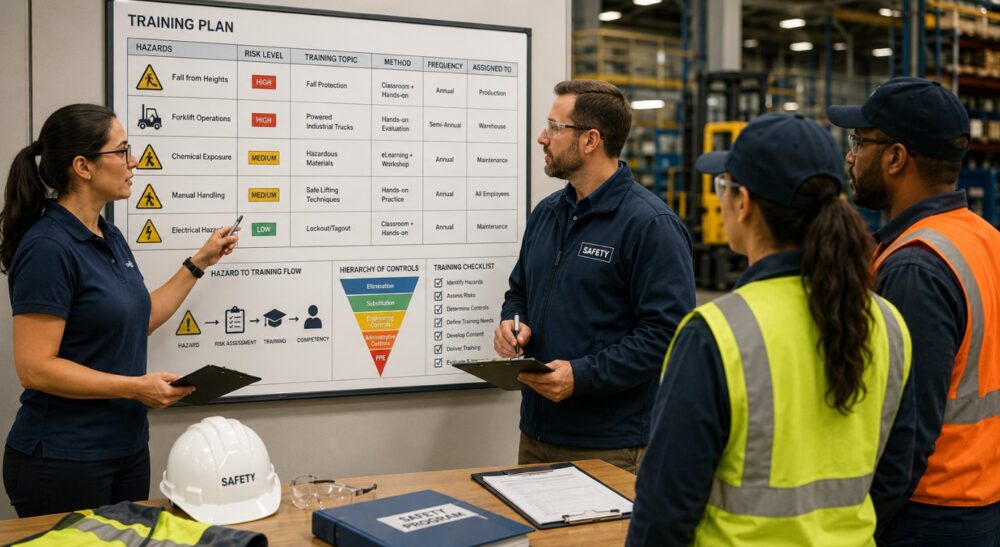
A good program begins with a hazard inventory. Walk the workplace with supervisors and workers. Review injury logs, near misses, inspection findings, maintenance records, chemical lists, job hazard analyses, and equipment manuals. Then connect each hazard to training, controls, and accountability.
NIOSH’s hierarchy of controls is useful here because it ranks protections from strongest to weakest: elimination, substitution, engineering controls, administrative controls, and PPE. Training usually sits in administrative controls, which means it matters, but it should not carry the whole burden when a hazard can be removed, redesigned, guarded, ventilated, or isolated.
A strong training program should include:
- A training matrix by job role, hazard, rule, and renewal trigger
- Short orientation for all workers, including temps and contractors
- Deeper task training for high-risk work
- Supervisor training on enforcement and coaching
- Plain-language materials in workers’ actual languages
- Records showing date, trainer, topic, attendees, and competence check
- A review cycle tied to incidents, inspections, and process changes
Digital learning platforms can help with reminders and records, but they are overhyped when used alone. A warehouse employee may complete a module on forklift safety and still need route-specific practice beside racks, pedestrians, blind corners, and loading docks.
Who Should Deliver Safety Training?

Safety training should be delivered by someone competent in the hazard, the work process, and the rule or procedure being taught. That person may be an in-house safety manager, supervisor, equipment vendor, outside consultant, occupational nurse, industrial hygienist, or OSHA-authorized Outreach trainer, depending on the topic.
For routine topics, internal supervisors often work best because they know real shortcuts, bottlenecks, and local hazards. For technical areas such as respirator programs, confined spaces, electrical safety, fall arrest design, or hazardous waste operations, outside expertise may be necessary.
The cheapest option is not always poor. The expensive option is not automatically better. The real test is whether the trainer can connect legal requirements to actual work and spot unsafe practice during demonstration.
What Records Should Employers Keep?
Employers should keep records that show what training occurred, who received it, who delivered it, when it happened, what material was covered, and how competence was checked. Some OSHA standards have specific documentation requirements, so recordkeeping should follow the applicable rule, not a generic HR template.
Good records help during OSHA inspections, insurance reviews, litigation, and internal investigations. They also prevent wasted retraining. A clear matrix can show that a worker needs fall-protection refresher training but does not need to repeat general orientation from scratch.
Records should never become the goal. A perfectly filed training binder has limited value if supervisors tolerate unsafe shortcuts on the floor.
Workplace Safety Training Checklist for Employers
Use a short checklist before launching or revising a program:
| Question | Why it matters |
| Have all job hazards been mapped by role? | Prevents generic training that misses real exposure |
| Are OSHA, state-plan, client, and industry requirements checked? | Avoids assuming federal minimums cover every location |
| Is training delivered in worker language and vocabulary? | Supports comprehension and compliance |
| Are high-risk tasks verified through demonstration? | Shows ability, not attendance |
| Are temporary workers and contractors included? | Reduces gaps at handoff points |
| Are records complete and easy to retrieve? | Helps during audits, inspections, and claims |
| Are near misses used to update training? | Turns weak signals into prevention |
Summary
Workplace safety training in 2026 should be specific, documented, language-appropriate, and tested through real work. Employers need more than annual videos and signed rosters. They need a system that links hazards, controls, legal duties, supervisors, records, and worker feedback.
The safest answer is often less exciting than a new platform or certification badge: identify the hazard, control it as high as possible in the hierarchy, train workers in terms they can apply, verify competence, and update the program whenever work changes.