


AI product development improves when teams base their choices on evidence instead of guesswork. Product teams face constant pressure to move quickly, reduce risk, and build features that solve actual user problems.
Smarter decision-making helps teams do all three by turning scattered signals into clear product direction.
AI’s strongest value is not only automation. Greater value comes through faster movement between a user signal and a product decision.
Evidence-backed product work gives teams a clearer path. Instead of relying only on instinct, teams can use AI to compare user needs, business goals, and product performance.
Human judgment still matters, but it becomes stronger when supported by better information.
Better User Insight

AI helps teams analyze customer feedback, interviews, reviews, support tickets, meetings, emails, and product usage data.
Product teams often have access to large amounts of user information, but that information can be scattered across tools, teams, and formats.
Without AI, manual review can take too much time and may cause important patterns to be missed.
AI can surface themes, tag pain points, and identify recurring language across hundreds of interactions in hours.
Several signals become easier to compare when AI organizes user input at scale.
- Repeated complaints can show which issues affect many users.
- Common feature requests can reveal demand across user groups.
- Confusing workflows can point to areas where users lose time.
- Emotional language can show frustration, urgency, or satisfaction.
As a result, teams can identify problems that affect many users instead of reacting only to loud individual requests. AI also helps teams detect hidden user needs.
Users may ask for a specific feature, but their actual problem may be broader.
By reviewing patterns across conversations, behavior, and product usage, AI can help teams see what users are trying to accomplish, where they struggle, and which improvements may matter most.
Faster Prototyping and Testing
AI tools can speed up design, coding, MVP creation, and testing.
Product teams can use AI to generate interface concepts, write early code, create test cases, summarize requirements, and compare solution options.
Faster execution gives teams more room to test ideas before making large investments.
AI-assisted tools can reduce product development timelines, especially for MVPs and prototypes, moving some work that once took months into days or even hours.
Goji Labs explains that functional AI prototypes can help teams test concepts, validate feasibility, and align stakeholders before committing to full development.
Early versions do not need to be perfect. Their purpose is to test assumptions, gather reactions, and learn quickly.
Early versions do not need to be perfect. Their purpose is to test assumptions, gather reactions, and learn quickly.
Rapid prototype work gives teams practical ways to compare options before committing major resources.
- Interface concepts can be tested before full design work begins.
- Early code can show technical feasibility sooner.
- Test cases can expose risks before release planning.
- MVPs can collect user reactions before a full build.
Multiple design or solution options can be generated quickly, then evaluated by humans.
Product managers, designers, engineers, and researchers can use their judgment to choose the best direction.
Faster prototypes help teams validate ideas early, reduce wasted effort, and avoid building full features before confirming user value.
Stronger Prioritization

AI helps organize ideas, compare feature value, and connect product decisions to business goals.
Product teams often manage long lists of requests, bugs, experiments, and roadmap ideas. Without a clear system, teams may spend time on low-value work while higher-impact opportunities wait.
AI can classify and tag customer feedback, identify gaps, and surface opportunities hidden inside large amounts of data.
Similar requests can be grouped together, duplicate items can be reduced, and conflicting backlog items can be flagged.
Clearer organization helps teams see which ideas support user needs, revenue goals, retention, adoption, or operational efficiency.
Stronger prioritization also improves backlog quality because AI can connect tickets to measurable user impact signals.
- Support volume can show how often a problem reaches customer-facing teams.
- Usage drop-offs can show where users stop moving through a workflow.
- Customer segment importance can help teams judge business value.
- Repeated complaints can raise urgency when the same issue appears across channels.
Teams can then focus on work with measurable value instead of choosing features based only on opinion or internal pressure.
Improved Team Alignment
AI can summarize meetings, requirements, decisions, and customer insights. Product development often involves many teams, including product, design, engineering, marketing, sales, support, and leadership.
Misalignment can happen when each group works with different notes, different interpretations, or different priorities.
Shared summaries and decision logs reduce confusion. AI can capture key decisions, open questions, action items, user evidence, and product reasoning in a format that teams can review later.
Better records help prevent repeated debates and keep teams connected to the same product direction.
AI also helps connect customer feedback with company goals. User needs can be compared with roadmap priorities, business targets, and technical limits. Several records can help teams stay aligned after meetings end.
- Decision logs can show what was agreed on and why.
- Action items can clarify ownership across teams.
- Customer insight summaries can keep user evidence visible.
- Requirement notes can reduce gaps between planning and execution.
As a result, teams can balance what users want with what the organization needs to achieve.
Continuous Improvement After Launch
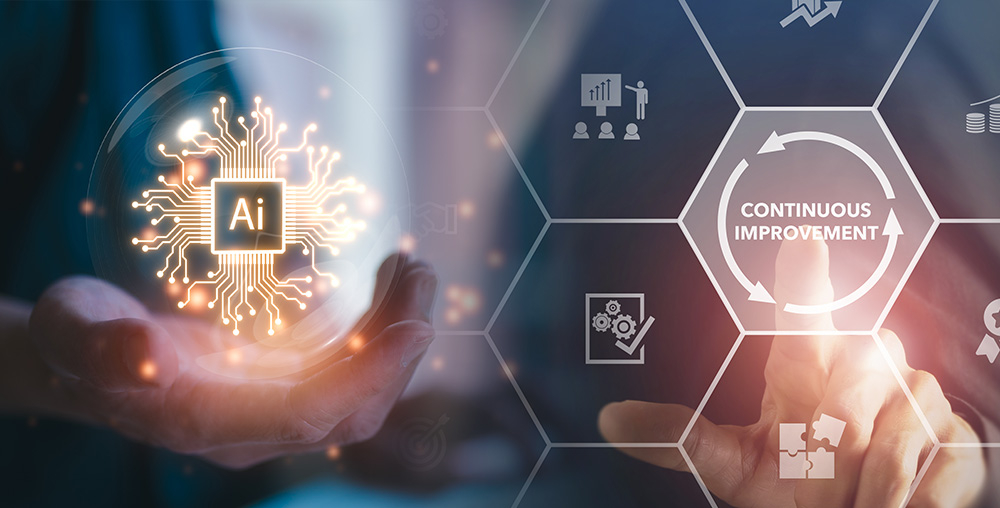
AI helps analyze post-launch feedback and product performance.
Launching a feature is not the end of product work. After release, teams need to know how users respond, which problems appear, and which improvements should come next.
AI can summarize app reviews, support tickets, sales calls, social mentions, and usage patterns within days instead of weeks.
Faster analysis helps teams spot confusion, bugs, adoption barriers, and unexpected user behavior. Product teams can then adjust features, fix problems, and improve user experience sooner.
A faster feedback loop makes product development more responsive. Launch insights can feed directly into roadmap decisions, backlog updates, and future experiments.
Each release becomes a learning opportunity that helps the next decision become smarter.
Post-launch signals can guide the next round of product work in specific ways.
- App reviews can reveal user sentiment soon after release.
- Support tickets can expose friction that users cannot solve alone.
- Sales calls can show objections or missing capabilities.
- Usage patterns can show which features gain traction and which ones stall.
Summary
Smarter decisions make AI product development more focused, efficient, and user-centered.
AI helps teams handle repetitive work, synthesize large amounts of information, and reveal patterns that may otherwise be missed.
AI works best when it supports human judgment rather than replacing it. Product teams still need strategy, creativity, empathy, and final decision-making.
AI provides stronger evidence, faster analysis, and clearer organization, while humans decide what should be built, why it matters, and how it should support users.